News
CDU student’s app aids construction safety in remote NT communities

A former Charles Darwin University (CDU) student has developed an augmented reality app to aid construction safety training in remote NT communities, and assist First Nations workers to learn and work on country while improving local housing.
Issues such as overcrowding, poor housing conditions and a severe housing shortage impact remote communities and there is a need to train local tradesmen to support community construction and maintenance projects.
CDU Master of Information Technology (Software Engineering) alumnus Anand Kujur created a game-based learning application that allows users to refresh their knowledge of safety risks and measures in the construction site.
“The application, called Safety First NT, really focuses on providing an interactive aid to help more effective and efficient learning at the work site,” Mr Kujur said.
“When local First Nations tradesmen aren’t involved in construction projects or away from community, their prior training may not be so easily recalled when they come back."
“We’re addressing this issue with a visual communication tool on a convenient, hand-held device that can be passed around the workers to help refresh their training.”
The number of First Nations people working in construction in the Northern Territory has increased over the last few years.
Local community members also provide additional work on construction sites, and perform general upkeep and maintenance of housing, when tradesmen from urban areas return to base.
“The app currently provides a visual display of how to wear personal protective equipment (PPE) on a construction site, complete with danger signage and the risk of falling debris. The mode of teaching can be adopted easily to other material.”
“Future versions can also include simulated guides of everyday home maintenance tasks, such as how to change a tap or tighten hinges on a door frame, to help community members repair their homes while tradesmen aren’t there.”
Project supervisor and CDU Information Technology lecturer Dr Cat Kutay said the application can also have an audio guide in different First Nations languages.
“The oral sharing of knowledge is such a strong and integral part of First Nations culture, so applying this familiar way of communication to our safety training app will allow construction workers to familiarise themselves quickly,” Dr Kutay said.
“Refreshing safety training regularly means skilled workers can learn remotely on country without having to leave and attend training hundreds of kilometres from home. It creates a stabilised workforce and brings in income to be shared with family and the community.
“Anand’s project is one of many we are working on at CDU in collaboration with First Nations communities and organisations to address digital needs with effective and sustainable solutions.”
CDU is also working on a more audio-visual approach to teaching practical units in communities and Mr Kujur’s app will provide a template to support this work.
For more information on IT and Network Engineering courses at CDU, visit here.
Related Articles

Darwin needs a BBL: Architecture student's vision for the Top End
A vertical promenade designed by a Charles Darwin University (CDU) architecture student and inspired by Singapore's Gardens by the Bay offers a glimpse into Darwin's future facelift.
Read more about Darwin needs a BBL: Architecture student's vision for the Top End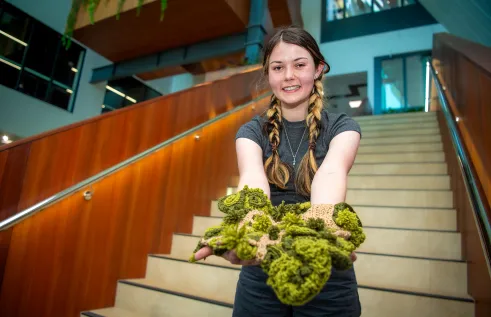
Crocheted landscape takes the gold in architecture competition
When tasked to defy growing reliance on artificial intelligence and create a landscape model without digital tools, Charles Darwin University (CDU) Bachelor of Architectural Design student Jorja Handebo turned to her hobby of the past five years: crochet.
Read more about Crocheted landscape takes the gold in architecture competition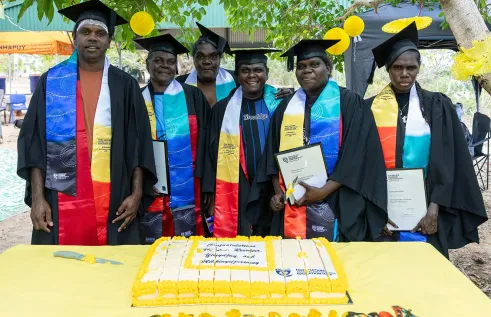
First Nations Training and Teacher Education Hub celebrates first major milestone
As Charles Darwin University's (CDU) First Nations Training and Teacher Education Hub draws closer to the end of its first year, one of its greatest milestones to date was conferring its first six graduates.
Read more about First Nations Training and Teacher Education Hub celebrates first major milestone


