Global body adopts policy to protect Earth’s old, wise and large animals
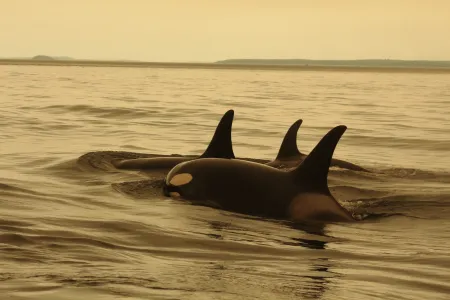
The International Union for Conservation of Nature (IUCN) has recognised Charles Darwin University-led research into the Earth’s oldest animals with the adoption of the ‘Longevity Conservation’ global policy principle.
The principle is one of 147 motions that were adopted at the IUCN’s World Conservation Congress in Abu Dhabi.
IUCN is an international body which unites governments, non-government organisations and scientists, to conserve nature and support sustainable development.
The policy, known as Motion 113, commits to ‘strengthening planning for preserving biodiversity through the use of Longevity Conservation approaches to ensure naturally age-structured populations' and passed with overwhelming support.
Longevity conservation was first developed from research led by academics from Charles Darwin University (CDU) to protect the Earth’s oldest animals.
The concept stemmed from a CDU-led research paper published in Science last year, which showed the loss of older creatures – often from overharvesting, poaching, or environmental degradation – undermines population stability, ecosystem resilience, and the transfer of knowledge within animal societies.
The original research, Loss of Earth’s old, wise and large animals, was conducted with an interdisciplinary team of researchers from CDU, the University of Exeter, Charles Sturt University, Macquarie University, the Amboseli Trust for Elephants in Kenya, University of Stirling, and Texas A&M University.
The motion is focused on old animals but has implications for large old-growth trees.
Ecologist and senior lecturer Dr R. Keller Kopf, from CDU’s Research Institute for the Environment and Livelihoods, was the lead author on the Science paper and said the research team worked closely with international partners to advocate for the motion.
“Older animals aren’t just survivors, they’re ecological cornerstones,” Dr Kopf said.
“They often guide migrations, stabilize reproduction, population and food web dynamics, and in some species, pass down cultural knowledge. Yet, current policies fail to recognise or protect them.”
The motion instructs the IUCN and members to:
- Develop monitoring and research frameworks to better assess the age structure of animal populations in relation to natural age-structure.
- Implement management strategies that explicitly protect older individuals, not just species.
- Incorporate age diversity into protected area planning and sustainable use policies including fisheries and wildlife management.
Dr Kopf said while Motion 113 was a major step forward, implementation now rests on collaboration between scientists, governments, and conservation practitioners.
“There’s still a long road ahead. We encourage researchers and policymakers worldwide to begin developing strategies to integrate longevity conservation principles into their programs,” Dr Kopf said.
Motion 113’s adoption aligns with international commitments including the UN Sustainable Development Goals, the Kunming–Montreal Global Biodiversity Framework, and Australia’s Threatened Species Strategy.
CDU Deputy Vice-Chancellor Research and Community Connection Professor Steve Rogers said the outcome reflected the University’s commitment to producing meaningful and impactful research.
“The purpose of high-quality research isn't just to know the nature of the problem, but to find a solution," Professor Rogers said.
"Motion 113's roots in research led by Charles Darwin University is testament to the practical applications of our academics' work, and I look forward to seeing the policy's positive impact on conservation efforts around the world."
Related Articles

Federal funding for Country-based health and climate resilience
A new research collaboration to support and strengthen Country-based health and climate resilience has received funding through the National Health and Medical Research Council’s Centres of Research Excellence scheme.
Read more about Federal funding for Country-based health and climate resilience
New livestream brings remote Australian arid zone waterhole to the world
A new livestream from a remote waterhole in the Northern Territory is giving people around the world the opportunity to observe wildlife in real time.
Read more about New livestream brings remote Australian arid zone waterhole to the world
Leading scientist recognised for lifetime of dedication to Australian biodiversity and conservation
One of the nation’s most distinguished experts in Australian biodiversity and conservation will be celebrated in an upcoming Charles Darwin University graduation ceremony.
Read more about Leading scientist recognised for lifetime of dedication to Australian biodiversity and conservation


