News
Indigenous students get ranger ready
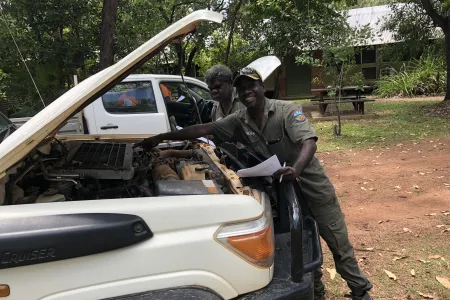
Remote Indigenous communities are learning valuable and useful skills as they are upskilled to become rangers through a course providing meaningful employment, training and career pathways for Aboriginal and Torres Strait Islander Australians.
Vocational Education and Training Lecturer, Murray Lauritsen, is one of the lecturers teaching a two-week intensive ranger ready program in Jabiru designed to support Indigenous people to combine traditional knowledge with conservation training to protect and manage their land.
The program, which saw about 100 students go through the course this year, was developed with coordination from ranger groups and the Northern Land Council.
The program includes practical skills training such as chemical use, machinery operations and maintenance, four-wheel driving and work health and safety.
“We encourage students to gain qualifications that give them a pathway to employment or promotion. The program helps students develop a skillset so they can be safe and confident doing their tasks,” Mr Lauritsen said.
It is a demand-based program welcomed by local students looking to upskill.
“There is no heavy reliance on students’ literacy and numeracy skills, and students can pass the unit based on their performance on practical tasks. It boosts their confidence and breaks down barriers.”
“We go out and listen to people in the communities. People love it when we turn up and the attendance is great,” he said.
“The best recognition is when the students ask us when we will come back. It’s a really rewarding experience.”
“There is a growing number of students and the interest is very high. Students are learning in an environment that they feel comfortable in and it’s a good opportunity to network,” Mr Lauritsen said.
Students are often encouraged by their employers to enrol in the course to develop or refresh their skillset.
“The program is beneficial to both employers and employees. We have a mixture of new rangers and experienced rangers who are here for a refresher course,” Mr Lauritsen said.
He also said CDU was looking to expand their services to more remote areas such as Urapunga, a community between East Arnhem Land and Gove.
The teaching staff were also invited by the Central Land Council to do a one-week intensive course in Alice Springs, which had more than 120 students.
Mr Lauritsen’s goal is to encourage more Indigenous students to think about obtaining a full qualification, which can be a Certificate II.
“It’s good to map out their study options. Going through a short course can boost their self-esteem and they can see that even if they didn’t finish school, they can still be qualified and receive a certificate,” he said.
“They can become good role models for the rest of their community. That’s my goal.”
Related Articles

Trainer’s passion to help students succeed recognised
While Veeramani Ramasami used his studies to launch an early career as an accountant and financial Manager, it was the encounter with his first accounting teacher that inspired him on a different path into education.
Read more about Trainer’s passion to help students succeed recognised
Prisoner education and skills training success
More than 2000 prisoners across the Northern Territory have taken part in education and skills training through a Charles Darwin University partnership with NT Corrections.
Read more about Prisoner education and skills training success
Quality and student success at the heart of new CDU TAFE leadership
Charles Darwin University (CDU) has appointed Claire Rasmussen as the next Pro Vice-Chancellor of CDU TAFE.
Read more about Quality and student success at the heart of new CDU TAFE leadership


