news article
Marine debris turned into stunning woven baskets
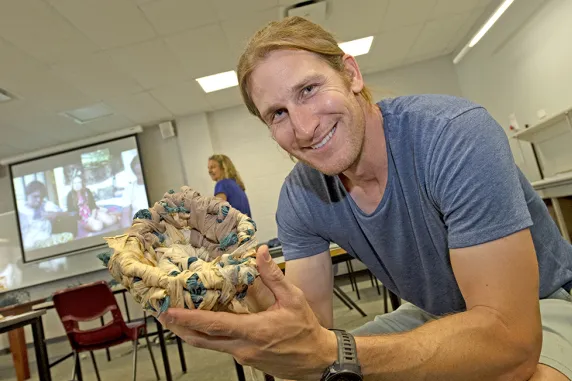
Using discarded marine debris to hand-craft traditional Groote Eylandt woven baskets was one of the highlights for students taking part in a five-day Charles Darwin University course this week.
The online weaving workshop was run by CDU PhD alumni Aly de Groote and artists from Groote Eylandt’s Anindilyakwa Arts, where students were taught how to craft baskets using discarded fishing “ghost” nets, other ocean debris and bush dyed textiles.
It was part of a course titled “Natural Resources and Indigenous Livelihoods”, held this week with the aim of exploring the synergies between natural resource-based enterprise development and Indigenous livelihoods.
Research Institute for the Environment and Livelihoods (RIEL) Associate Professor Natasha Stacey organised the course and said the basket weaving exercise was one of many activities students took part in.
“Students used marine debris collected by rangers out at Groote Eylandt to weave the baskets,” she said.
“The intensive course provides an opportunity to introduce the students to diverse types of enterprise that Indigenous people are involved in.
“It’s not just about generating income and profit, but for all the other benefits associated with using natural resources and the environment to create an enterprise.
“The students have been exposed to a whole range of industries and have learnt about the various social, economic and environmental factors involved in developing and supporting Indigenous enterprise development in the Northern Territory.”
Other aspects of the course involved field trips to the Darwin Aquaculture Centre at Channel Island, where students learnt about an Indigenous oyster program, and a cultural tour with Pudakul Tours at Fogg Dam.
The two days of field trips were integrated with three days of lectures, guest speakers and group discussions.
Students also experienced a meeting with Larrakia rangers at Dripstone Cliffs and a visit to the Aboriginal Bush Traders shop in Darwin City.
Related Articles
New livestream brings remote Australian arid zone waterhole to the world
A new livestream from a remote waterhole in the Northern Territory is giving people around the world the opportunity to observe wildlife in real time.
Read more about New livestream brings remote Australian arid zone waterhole to the world
Leading scientist recognised for lifetime of dedication to Australian biodiversity and conservation
One of the nation’s most distinguished experts in Australian biodiversity and conservation will be celebrated in an upcoming Charles Darwin University graduation ceremony.
Read more about Leading scientist recognised for lifetime of dedication to Australian biodiversity and conservation
First Nations ranger knowledge reveals the threats facing NT’s green turtles
First Nations ranger groups working in protected areas such as national or marine parks identified illegal commercial fishing as a major concern for the Northern Territory’s green turtle populations, a study led by Charles Darwin University (CDU) and James Cook University (JCU) has found.
Read more about First Nations ranger knowledge reveals the threats facing NT’s green turtles


