News
New research partnership to champion water security for Northern Australia
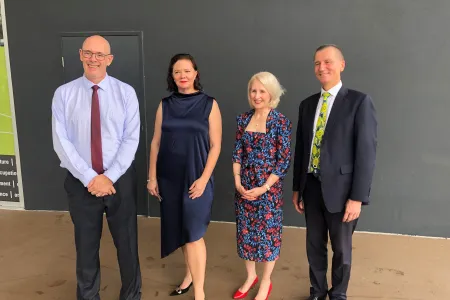
Three universities with headquarters in the north are partnering with the Cooperative Research Centre for Developing Northern Australia (CRCNA) to develop a comprehensive program of research focused on water security in Northern Australia.
Charles Darwin University (CDU), CQUniversity Australia (CQU) and James Cook University (JCU) will partner with the CRCNA to jointly deliver flagship research activities that address water infrastructure and security knowledge gaps required to inform key decision-making.
CDU Vice-Chancellor Professor Scott Bowman said the partnership would enhance CDU’s existing research capabilities, with water infrastructure and security a key driver for developing Northern Australia.
“This exciting partnership will put the Territory at the forefront of water infrastructure and security research – and ensure a sustainable future for Northern Australia,” Professor Bowman said.
“This program will lead to the future development of agriculture, food and aquaculture industries, improve health outcomes for Territorians and assist business development opportunities for First Nations’ businesses.”
CRCNA CEO Anne Stünzner said the investment partnership will deliver a program of works across several transformative research initiatives across the north.
“We are seeing enormous interest from the private and corporate sector in underpinning water investment for agricultural production. This partnership acknowledges the full potential of Northern Australia and this co-investment is a vital opportunity to demonstrate that agricultural growth and environmentally healthy and sustainable eco-systems can coexist in a water context.”
Some of the areas the CRCNA are interested in addressing through this co-investment include improving governance models around water resource allocations, including First Nations’ interests, addressing water security to better support agricultural diversification and water trading opportunities and improving water service delivery to remote and regional areas, including First Nations’ communities.
Mrs Stünzner said the objective of the program of research activities is to de-risk the Northern Australia investment and development landscape by improving water sustainability across the region and providing a pathway for the future development of key sectors as well as improving the health and wellbeing of the north’s communities.
JCU Vice-Chancellor Professor Sandra Harding said the new research partnership will harness the collective knowledge of all three universities and maximise water security into the future.
“Our aspiration is to grow and deploy our collective strengths, expertise and presence in research areas that matter to develop and retain the skills and capabilities of industry and community across Northern Australia,” Professor Harding said.
“Being based in the north, all three universities share both the context and operating challenges that are unique to Northern Australia to push the boundaries of water research to help secure water supply and security to Northern Australia for years to come.”
CQU Vice-Chancellor Professor Nick Klomp said the partnership was a strong example of institutions working together for the future sustainability of Northern Australia.
“Northern Australia makes up almost half the landmass of our vast continent, with an urgent need for new knowledge and innovative solutions across environmental, industrial and cultural dimensions,” Professor Klomp said.
“We’re confident that the research activities of Northern Australia will go from strength-to-strength over the coming years as a result of this collaboration.”
Related Articles
Federal funding for Country-based health and climate resilience
A new research collaboration to support and strengthen Country-based health and climate resilience has received funding through the National Health and Medical Research Council’s Centres of Research Excellence scheme.
Read more about Federal funding for Country-based health and climate resilience
New livestream brings remote Australian arid zone waterhole to the world
A new livestream from a remote waterhole in the Northern Territory is giving people around the world the opportunity to observe wildlife in real time.
Read more about New livestream brings remote Australian arid zone waterhole to the world
Leading scientist recognised for lifetime of dedication to Australian biodiversity and conservation
One of the nation’s most distinguished experts in Australian biodiversity and conservation will be celebrated in an upcoming Charles Darwin University graduation ceremony.
Read more about Leading scientist recognised for lifetime of dedication to Australian biodiversity and conservation


