The Dr Bilawara Lee OAM (Aunty B), Faculty of Health Public Lecture
| Presenter | Bernard Salt AM | |
|---|---|---|
| Date/Time |
to
|
|
| Contact person |
Kristine Evans
|
|
| Location | Education and Community Precinct, 54 Cavenagh Street, Darwin City | |
| Open to | CDU staff and students, Public | |
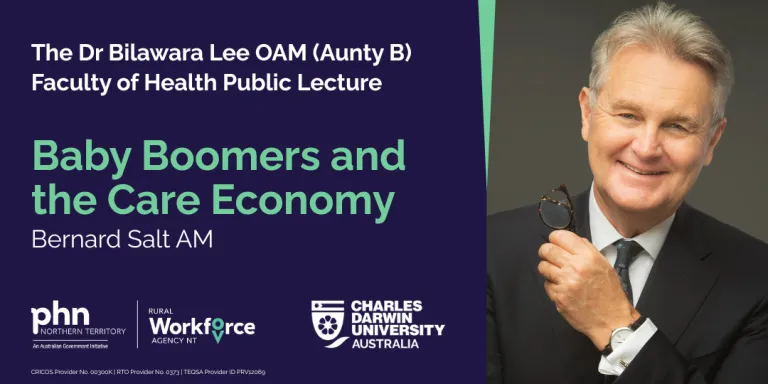
Baby Boomers and the Care Economy - Planning for Healthcare in Australia, 2026 - 2036.
Keynote address by Bernard Salt AM.
Planning for Peak Healthcare in Australia, 2026-2036
How demographics, consumer preferences & social behaviour are reshaping the care economy
Demographer, columnist and business advisor Bernard Salt AM argues that Australia will move through a period of peak healthcare demand over the decade to 2036, driven by both demographic change and shifting consumer expectations.
The first wave of baby boomers (born 1946–1964), particularly those born in the late 1940s, are now entering their high-care years in their 80s, bringing with them not only increased service demand but also a more assertive voice around treatment options, care quality and cost - an outlook often reinforced by their Millennial adult children.
However, the emergence of “peak healthcare” is not solely demographic. Since COVID, there has been a marked shift towards wellness, self-care, fitness and appearance, reflecting and extending Australia’s long-standing lifestyle focus. The ‘café society’ of the previous decade is evolving into a broader ‘care economy’, where wellness has become embedded not only in health behaviours but also in culture and even fashion active wear being a visible example.
This lecture offers an insightful, evidence-based exploration of how these converging forces are reshaping demand across healthcare, wellness and the wider care economy, highlighting the areas and needs for our future health workforce.
This event is supported by funding from the Northern Territory Primary Health Network (Northern Territory PHN) and Faculty of Health, CDU.
Important Notice: This Event Will Be In-Person and Online.
Register to attend
Related Events
Last refugium of a critically endangered species: Three decades of conservation
The Banggai Crow (Corvus unicolor), is one of the world’s most threatened endemic species. The bird survives in an increasingly fragmented refugium within the Banggai Archipelago, Central Sulawesi.
Read more about Last refugium of a critically endangered species: Three decades of conservation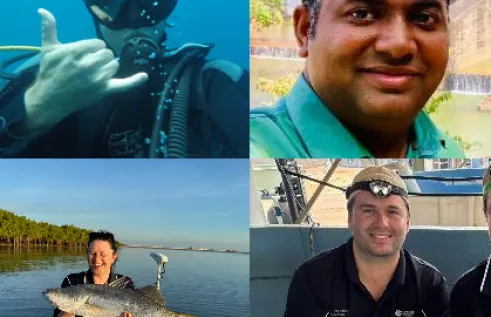
Marine science in the NT: From research and monitoring to stock assessment
In this seminar, the team will provide an overview of fisheries research in the Northern Territory, highlighting monitoring programs, data collection, and how these activities inform stock assessment and fisheries management
Read more about Marine science in the NT: From research and monitoring to stock assessment
Casuarina Open Day
Join us on Saturday 8 August, and explore the Casuarina Campus. See the labs, meet the people who teach and study here, and picture a future you can build without ever leaving the Territory.
Read more about Casuarina Open Day


