news article
CDU lecturer bestows time legacy
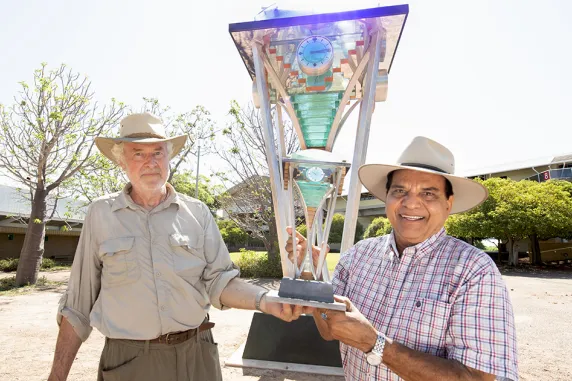
A large solar-powered clock tower standing four metres high and shaped like an hourglass has been installed at Charles Darwin University’s Casuarina campus.
The vision of CDU Emeritus Professor of Physics Jai Singh, the clock was created by Paul Johnson from ArtVenture.
Professor Singh said several ideas were put forward for the clock’s design, with the hourglass theme eventually finalised with a historical note in mind.
“I realised that there was no clock tower on the campus, so the idea of a solar clock originated in my mind - to be powered by solar panels and inspired by my research activities on solar cells during my long tenure at CDU,” he said.
“The hourglass, or sand clock, first appeared in France in the 8th Century. Its form invites endless sculptural interpretations as well as linking historic and contemporary time measurement systems.”
Professor Singh has worked on solar energy research at CDU for more than three decades and spent considerable time working with the design team to develop the impressive timepiece.
“My main inspiration is very emotional and personal … in a way my professional career developed at CDU and hence I regard my relationship with CDU to be my professional motherhood,” he said.
“I wanted to do something in return.”
During his 33-year tenure at CDU, Professor Singh did not take his long service leave, which had accumulated to almost a year.
“So I donated my long-service leave back to CDU to build the solar clock,” he said.
“I am very happy and pleased that it has materialised and delighted to know it will be there for the CDU community for years to come.”
The “Jai Singh Solar Clock” is located in CDU’s Boab Court.
Related Articles
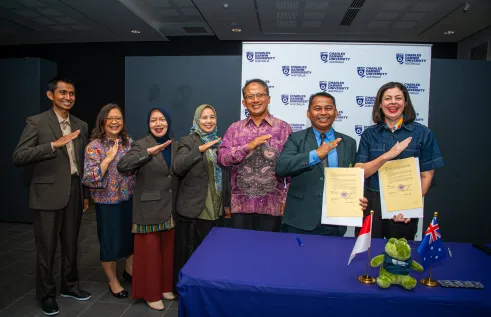
Partnership with Indonesian university to support education and research
A new partnership with one of East Java’s leading education institutions is aligning Charles Darwin University with priorities to strengthen Australia’s relationship with Indonesia.
Read more about Partnership with Indonesian university to support education and research
Darwin needs a BBL: Architecture student's vision for the Top End
A vertical promenade designed by a Charles Darwin University (CDU) architecture student and inspired by Singapore's Gardens by the Bay offers a glimpse into Darwin's future facelift.
Read more about Darwin needs a BBL: Architecture student's vision for the Top End
CDU improves standing in Times Higher Education rankings
Charles Darwin University (CDU) has improved its standing across all five categories in the 2027 Time Higher Education World University Rankings.
Read more about CDU improves standing in Times Higher Education rankings


