News
First Nations women take a step into STEM at CDU
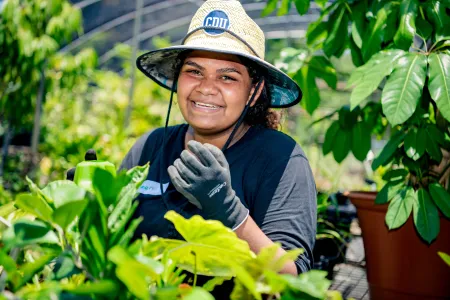
First Nations students from across the Northern Territory are getting a taste of STEM subjects and career pathways as part of a pre-STEM program held at Charles Darwin University (CDU) this week.
Twelve female students aged 17 to 40 from across the Territory, including Katherine, Jabiru, West Arnhem Land and Darwin, have travelled to CDU’s Casuarina campus for the First Nations Pre-STEM program held from October 31 to November 6.
In partnership with Power and Water, the program provides participants with an opportunity to visit CDU and get involved in workshops and activities across all areas of science, technology, engineering and maths.
CDU College of Engineering, IT and Environment STEM Pathways Lecturer Dr Carla Eisemberg said the program supports education opportunities at both VET and Higher Education levels.
“Some of these students have little experience of STEM in VET or higher education, while others are completing a Certificate III in Conservation and Land Management,” Dr Eisemberg said.
“We’re really looking forward to welcoming these women to CDU and providing a wide variety of activities to meet and expand their skillsets. Their perspectives and knowledge offer a new level of insight and innovation.”
Spanning over a week, participants will visit local industries that employ STEM professionals in the NT, as well as interactive workshops at CDU and social activities to connect with STEM mentors in their area of interest.
Students will take part in activities related to wildlife conservation, robotics, and aviation, as well as a visit to Power and Water Corporation.
Power and Water’s Deputy CEO John Pease said the site tour will provide an insight into the wastewater treatment process, where our wastewater comes from and what exactly we do with it once it gets to the stabilisation ponds.
“We are looking forward to hosting the group onsite with our team of experts available to speak about the wastewater treatment process and operations onsite,” Mr Pease said.
“We are proud of our ongoing partnership with CDU and for the opportunity to help grow local skills and capabilities for the next generation of STEM professionals.”
CDU Vice Chancellor Professor Scott Bowman said the program provides a great opportunity for First Nations students to learn about different science-focused educational pathways.
“Programs like this are hugely important in encouraging more First Nations students to explore STEM pathways in higher education and take a stepping stone into future careers,” Professor Bowman said.
“Through the First Nations Pre-STEM program, an engaging range of activities will show the impact of STEM in our everyday lives and the variety of career options available to them here in the Territory,” Professor Bowman said.
The program is funded under the Australian Government’s Higher Education Participation and Partnerships Program (HEPPP).
Related Articles

Darwin needs a BBL: Architecture student's vision for the Top End
A vertical promenade designed by a Charles Darwin University (CDU) architecture student and inspired by Singapore's Gardens by the Bay offers a glimpse into Darwin's future facelift.
Read more about Darwin needs a BBL: Architecture student's vision for the Top End
Trainer’s passion to help students succeed recognised
While Veeramani Ramasami used his studies to launch an early career as an accountant and financial Manager, it was the encounter with his first accounting teacher that inspired him on a different path into education.
Read more about Trainer’s passion to help students succeed recognised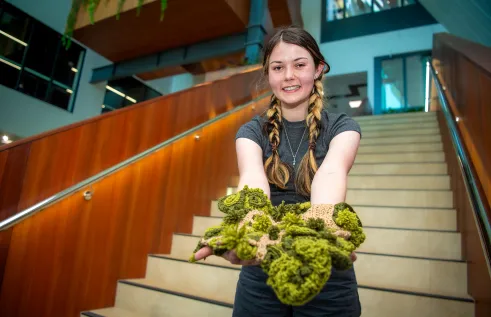
Crocheted landscape takes the gold in architecture competition
When tasked to defy growing reliance on artificial intelligence and create a landscape model without digital tools, Charles Darwin University (CDU) Bachelor of Architectural Design student Jorja Handebo turned to her hobby of the past five years: crochet.
Read more about Crocheted landscape takes the gold in architecture competition


