News
On the road to cheaper, safer commutes with CDU’s new research hub
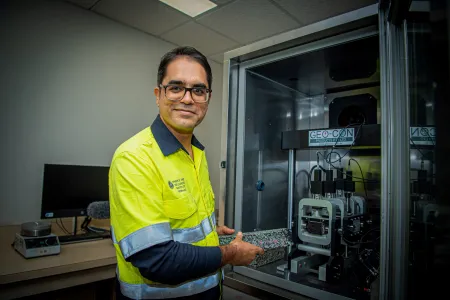
The Northern Territory is on the road to smoother, safer commutes with innovative support and research from Charles Darwin University’s (CDU) new Centre for Asphalt and Road Technologies (CART).
CART will expand on existing work carried out through the University’s pavement research program, which commenced in 2024 with funding support from the NT Government’s Department of Logistics and Infrastructure (DLI) and Tyre Stewardship Australia (TSA).
The team behind the Centre, led by CDU Senior Lecturer of Engineering Dr Ali Rajabipour, has the capability and expertise to deliver high-impact research, innovation, and technical services in pavement and road technologies – all of which are in growing demand in the NT.
Dr Rajabipour said his team’s work spanned multiple elements of road research and development, which helps drive industry collaboration, and commercialisation of technology breakthroughs.
“Bringing this breadth of activity together requires a dedicated hub – one that can coordinate partnerships, streamline engagement with industry and government, and translate research into real-world outcomes for the NT,” Dr Rajabipour said.
“At its core, the Centre is about delivering better-quality roads that last longer and cost less to maintain.
“This means safer travel, reduced disruption, and better use of public funds – outcomes that directly benefit communities across the Northern Territory.”
The Centre is the latest initiative operated through CDU’s Energy and Resources Institute, which focuses on developing sustainable and environmentally friendly solutions in the energy and resources sectors.
CDU Energy and Resources Institute (ERI) Director Professor Maurizio Cirrincione said expanding the pavement team’s research through CART was a major step for the University and the Northern Territory.
“CART will provide the region with dedicated expertise in sustainable, climate‑resilient road technologies at a time when reliable infrastructure is critical,” Professor Cirrincione said.
“CART reinforces CDU’s position as a leader in applied research for the Northern Territory. This Centre will help improve local roads, support emerging industries, and create new opportunities for students, researchers and Territory businesses.
“I’m excited to see CART strengthen our ability to deliver high‑impact research, real-world testing and industry collaboration. The development of advanced facilities, including our path toward NATA accreditation, will greatly enhance our capability to support Territory infrastructure.”
The technologies and techniques developed in CART will directly benefit NT road users and taxpayers, but it can also be adapted for global applications. CART can provide the expertise and experimentation opportunities, that may not be afforded to other countries that need more resilient road infrastructure.
Aligned with the United Nations Sustainable Development Goals
Sustainable cities and communities
Goal 11
Make cities and human settlements inclusive, safe, resilient and sustainable.
Responsible consumption and production
Goal 12
Ensure sustainable consumption and production patterns.
Related Articles
Federal funding for Country-based health and climate resilience
A new research collaboration to support and strengthen Country-based health and climate resilience has received funding through the National Health and Medical Research Council’s Centres of Research Excellence scheme.
Read more about Federal funding for Country-based health and climate resilience
New livestream brings remote Australian arid zone waterhole to the world
A new livestream from a remote waterhole in the Northern Territory is giving people around the world the opportunity to observe wildlife in real time.
Read more about New livestream brings remote Australian arid zone waterhole to the world
Leading scientist recognised for lifetime of dedication to Australian biodiversity and conservation
One of the nation’s most distinguished experts in Australian biodiversity and conservation will be celebrated in an upcoming Charles Darwin University graduation ceremony.
Read more about Leading scientist recognised for lifetime of dedication to Australian biodiversity and conservation


