Forensic scientists issue call to arms to build forensic intelligence capability
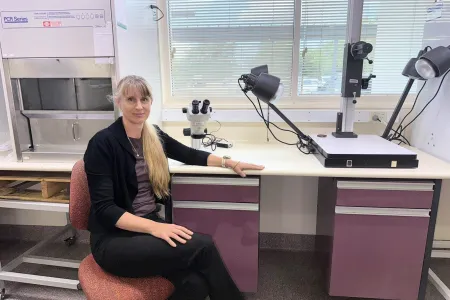
Forensics has well-recognised application in the courtroom, but a new report is arguing the science has much more to give.
Forensic intelligence (FORINT) has the potential to provide critical insights at all stages of an investigation - including proactively - to disrupt criminal activity and enhance public safety, according to researchers from both academia - Charles Darwin University (CDU), and operational forensics - Australian Federal Police (AFP), Northern Territory Police (NTP), New South Wales Police Force (NSWPF), and Western Australia’s PathWest Laboratory Medicine.
"FORINT is a means of maximising the utility of forensic science in policing,” CDU Faculty of Science and Technology Adjunct Professor, NTP Chief Forensic Science Officer, and the report’s co-author, Dr Joannah Lee, explained.
"It can be used to target systemic crime problems or criminal actors in a way that complements traditional intelligence approaches (using scientific insights to fill gaps in intelligence requirements).
"Collaboration and sharing are key: breaking-down siloes is a necessary prerequisite to allow cross-case, cross-domain analyses."
The research revealed numerous roadblocks to the effective application of FORINT in Australia and New Zealand, including across culture, organisation and operating environment, information management, and education and training.
For example, the separation of forensic science from its intelligence functions led to real and/or perceived tension between intelligence and prosecutorial outcomes, limiting opportunities and running contrary to a disruption-centric model of addressing and managing crime.
A lack of understanding of the exact role of FORINT within an organisation - with some personnel fully engaged and others "barely aware of its capability and potential" - was also found to hinder implementation, leading to missed operational opportunities and a lack of interoperability.
The report shows that unifying disparate information management systems enhances the ability of law enforcement to systematically exploit forensic opportunities to target criminal entities operating within and across borders.
“The operational advantages of FORINT have been well evidenced, with successes in crime prevention and disruption across the country,” lead author and AFP Forensics Coordinator Dr Michael Taylor said.
“Early implementation of FORINT in Australia was piloted in the Australian Capital Territory, where 80 per cent of property crime is attributable to serial offenders.
“The FORINT unit targeted offenders via systematic cross-case collection, holistic analysis of biometrics, and shoe-marks and behavioural factors alongside case data and open-source information.
“Following this, burglary reports were halved, and this FORINT project is now delivered business-as-usual by the AFP."
Acknowledging the risks associated with implementing FORINT - including privacy, confidentiality, bias and misinterpretation – Dr Lee explained these factors were not exclusive to the discipline.
"These issues are outweighed by the risks of not implementing FORINT - such as failure to reveal threats, missed opportunities and poor resource efficiency," Dr Lee said.
“For policing and forensic science laboratories, now is the time to implement and entrench FORINT.
“For academia, now is the time to build foundations for this future.
“And for supporting industries, now is the time to develop partnerships and facilitate delivery.”
The report, Forensic intelligence in Australia and New Zealand: Status and future directions, was published in Forensic Science International.
Related Articles

Federal funding for Country-based health and climate resilience
A new research collaboration to support and strengthen Country-based health and climate resilience has received funding through the National Health and Medical Research Council’s Centres of Research Excellence scheme.
Read more about Federal funding for Country-based health and climate resilience
New livestream brings remote Australian arid zone waterhole to the world
A new livestream from a remote waterhole in the Northern Territory is giving people around the world the opportunity to observe wildlife in real time.
Read more about New livestream brings remote Australian arid zone waterhole to the world
Leading scientist recognised for lifetime of dedication to Australian biodiversity and conservation
One of the nation’s most distinguished experts in Australian biodiversity and conservation will be celebrated in an upcoming Charles Darwin University graduation ceremony.
Read more about Leading scientist recognised for lifetime of dedication to Australian biodiversity and conservation


