News
Hub to drive agricultural research and innovation
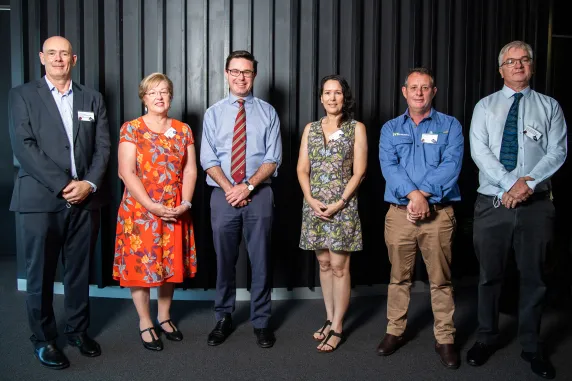
Partners of the Northern Western Australia and Northern Territory (NWANT) Drought Resilience Adoption and Innovation Hub welcomed Minister for Agriculture and Northern Australia David Littleproud in Darwin yesterday.
The Minister expressed his strong support for the Hub program and his vision for the role of regional universities in both supporting the hub program and driving agricultural research and innovation.
Charles Darwin University (CDU) Provost Mike Wilson and Acting PVC Research and Innovation Steve Rogers briefed the Minister on the plans for the Hub at CDU’s Darwin Waterfront Campus.
Mr Rogers said the Hub would play an important role in leading future agricultural research.
"Primary producers will be able to help drive and shape future research in agriculture that will directly benefit their livelihoods and operations,” Mr Rogers said.
Minister Littleproud welcomed this new initiative and acknowledged CDU’s role in developing key research in tropical agriculture.
“The new pillar of agriculture is research and development and technology and CDU will play a key role in that, particularly in the tropics,” Minister Littleproud said.
“We want to build the capacity of universities and commodity research development corporations and for the entire science, research and technology space for the agriculture sector.”
They were joined by Hub partners including NT Department of Industry Tourism and Trade, NT Farmers Association and Territory Natural Resource Management.
NT Farmers CEO Paul Burke said this program could improve efficiency and productivity in combating drought.
“Bringing everyone together in the same room breaks down some silos and creates some efficiency to deliver outcomes in a more cost-effective manner,” Mr Burke said.
“By directly dealing with farmers on the ground that are impacted by drought and water deficiencies we can increase productivity while also protecting our valuable resources into the future,” he said.
The next stages for the Hub, supported by the Australian Government, will see the recruitment process for the Hub Director and knowledge broker positions.
Regional hubs in Katherine, Alice Springs and regional Northern WA will be established and a series of planning and stakeholder engagement workshops will define the workplan.
A Hub partner regional contact point will be established either at the CDU Katherine Regional Campus or at the NT DITT Katherine Research Station.
The NWANT Hub coordinating Group includes Charles Darwin University, the Northern Territory Cattleman’s Association, Kimberley Pilbara Cattlemen’s Association, Northern Territory Farmers Association, Territory Natural Resource Management, the Rangelands Natural Resources Management, Regional Development Australia NT and the Western Australia and Northern Territory Governments.
Related Articles
Federal funding for Country-based health and climate resilience
A new research collaboration to support and strengthen Country-based health and climate resilience has received funding through the National Health and Medical Research Council’s Centres of Research Excellence scheme.
Read more about Federal funding for Country-based health and climate resilience
New livestream brings remote Australian arid zone waterhole to the world
A new livestream from a remote waterhole in the Northern Territory is giving people around the world the opportunity to observe wildlife in real time.
Read more about New livestream brings remote Australian arid zone waterhole to the world
How ants are cashing in on the fight against money laundering
An AI model inspired by ants, bees, and birds could be the key to cracking down on blockchain-based money laundering, new research led by Charles Darwin University (CDU) has found.
Read more about How ants are cashing in on the fight against money laundering


