News
Testing facility taking part in the innovative Alice Springs Future Grid project
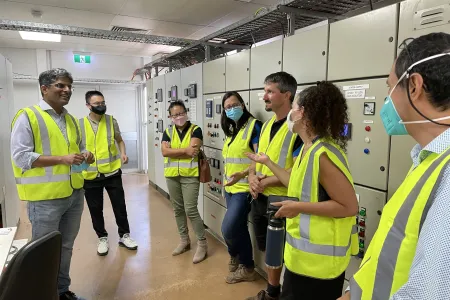
Charles Darwin University (CDU) has teamed up with the Alice Springs Future Grid project to help investigate how the Central Australian town can use more renewable energy.
Future Grid will test components at CDU’s Renewable Energy Microgrid Hub for Applied Research and Training (REMHART) in Darwin for their suitability for real-world application.
CDU’s Energy and Resources Institute Director Professor Suresh Thennadil said this was exactly why the microgrid was constructed.
“In the coming years, not decades, we will need a revolution in power generation and distribution that has not been seen since the initial rollout of a national power grid,” Professor Thennadil said.
“The testing facility is a vital tool in making this power revolution happen in the NT, with research and testing of new renewable systems, and training provided to build industry capacity.”
Alice Springs Future Grid is a whole-of-system, multi-stakeholder project considering how Alice Springs can achieve 50 per cent renewable energy by 2030.
Future Grid Project Director Lyndon Frearson, from Alice Springs engineering firm Ekistica, said CDU’s ability to facilitate this testing underscored how new opportunities, trials and partnerships can be developed in the Northern Territory.
“The people involved with the facility at CDU have been working alongside the Alice Springs Future Grid project since its inception,” Mr Frearson said.
"This partnership demonstrates how research and industry can collaborate, drive innovation, and build local capacity.”
Individual solar, hybrid and battery inverters have now been installed at REMHART and will be tested for Essential System Services response characteristics including delay time, ramp time and maximum charge and discharge power outputs under different load and generation scenarios. CDU staff will be conducting testing of the inverters.
Professor Thennadil said Future Grid had a significant role to play in identifying and overcoming the barriers to reaching the NT’s 50 per cent by 2030 renewable energy target in Alice Springs.
“This is a great opportunity for our researchers to apply their skills to challenges relevant to industry and our communities while, at same time, developing their connections with our Future Grid Partners,” he said.
“The inverter testing, via the Future Grid project, will demonstrate REMHART’s ability to bring together industry and academic researchers. Additionally, we expect the results from this study to inform our future research direction.”
Related Articles
Federal funding for Country-based health and climate resilience
A new research collaboration to support and strengthen Country-based health and climate resilience has received funding through the National Health and Medical Research Council’s Centres of Research Excellence scheme.
Read more about Federal funding for Country-based health and climate resilience
New livestream brings remote Australian arid zone waterhole to the world
A new livestream from a remote waterhole in the Northern Territory is giving people around the world the opportunity to observe wildlife in real time.
Read more about New livestream brings remote Australian arid zone waterhole to the world
Leading scientist recognised for lifetime of dedication to Australian biodiversity and conservation
One of the nation’s most distinguished experts in Australian biodiversity and conservation will be celebrated in an upcoming Charles Darwin University graduation ceremony.
Read more about Leading scientist recognised for lifetime of dedication to Australian biodiversity and conservation


