Transport study reveals why journey is as important as the destination
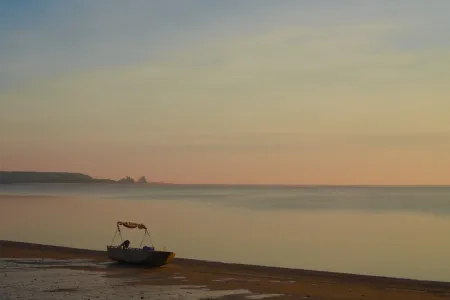
A days’ long canoe voyage along the Arnhem Land coast can now be completed within hours in a tinnie, but accelerating movement has unique and complex implications for Indigenous peoples’ relationship with their ancestral Country, according to a new research paper.
The research focuses on the impact of technological advancements on maritime transport, examining historic and contemporary journeys between the Northern Territory towns of Warruwi and Maningrida in north central Arnhem Land, a voyage of more than 250km.
Author Sam Williams, who is a PhD candidate from Charles Darwin University’s (CDU) Northern Institute, collaborated with Elders and Traditional Owners Samuel, Henry, Jack and their families from Maningrida to understand how the transition from travelling in dugout canoes to motorboats and helicopters has changed Indigenous peoples’ relationship with their ancestral Country.
During fieldwork conducted between 2023 and 2024, the Elders shared the ways they interacted with the land as time and technology progressed.
Samuel recounted travelling as a child by dugout canoe between Warruwi and Maningrida and during these journeys, listening to and watching his Elders as they interacted with the land and sea.
Samuel said: “When we were travelling with the canoe, we used to stop and camp. My mother, she used to tell us, ‘Come on you boys, make a big fire and I’ll tell you all these sacred site areas.’”
The knowledge shared included the names of places, if and how to engage with landscapes, ancestral stories and more.
The last canoe to travel between Maningrida and Warruwi set sail in 1982, and the transition to motorised tinnies has brought significant changes to people-place relations.
Reduced travel time has eliminated the need to camp, and the accessibility of tinnies means Elders and their children or grandchildren travel together less.
For Samuel, Henry and Jack, the slow, quiet movement in a canoe that helped them learn their embodied obligations to their Country is being replaced by journeys which make such learning challenging.
“The point is that the way we move is intimately connected to the way we know,” Mr Williams said.
“All our lives are getting faster and faster as technology enables us to travel further and communicate instantly across great distances.
“From one perspective, the barriers of ‘remoteness’ have been reduced by the acceleration of travel between Maningrida and Warruwi. In some ways, Country has never been closer and faster to access.
“And yet, paradoxically, this acceleration has not facilitated the kinds of encounter between people and their Country that my collaborators in Maningrida are deeply concerned about.
“Moving faster can unsettle the possibilities for interaction that involves sitting near, listening, observing and engaging.
“I think this conversation is particularly important against a backdrop of government policy that has sought to make towns like Maningrida and Warruwi larger while limiting support for outstations. Spending time on one’s own Country can be highly restricted.
“These structural constraints mean that those I have been working with are eager to seize whatever (limited) opportunities come their way to interact with their Country, but not all these opportunities facilitate the kinds of encounters they really want to see take place.”
This research is part of a larger project commissioned by Elders and knowledge holders living in Maningrida to experiment with new methods to renew and maintain the relationship between people and their Country. The group have been making a series of video resources to familiarize younger generations of their families in Maningrida with important ancestral places.
“This is for the new generation, so they can see, so they can learn more," Samuel said.
"We made these videos for future generations, so they can watch and learn about this country and know who their families are – to learn about kunak (country) and nguya (clans).”
Of canoes, tinnies and helicopters: contemporary maritime mobility and place relations in north central Arnhem Land was published in the journal Maritime Studies.
Related Articles

The good, the bad, and the ugly food: Why religious shoppers are buying bruised veggies
A recent study with Charles Darwin University examines how consumers’ religiosity influences the purchase of “ugly foods”, or foods that are aesthetically imperfect but nutritious.
Read more about The good, the bad, and the ugly food: Why religious shoppers are buying bruised veggies
Rangers reimagine AI in wildlife monitoring
As workplaces around the world wrestle to integrate Artificial Intelligence in their operations, researchers and rangers in the heart of West Arnhem are successfully embracing this technology in conservation without compromising respect and knowledge.
Read more about Rangers reimagine AI in wildlife monitoring
Partnership with Indonesian university to support education and research
A new partnership with one of East Java’s leading education institutions is aligning Charles Darwin University with priorities to strengthen Australia’s relationship with Indonesia.
Read more about Partnership with Indonesian university to support education and research


