
Update your personalisation settings to view information about this course.
This course is only available to Domestic students and your preference is currently set to International.
This course is only available to International students and your preference is currently set to Domestic.
Key details
Duration
Locations
Entry requirements
View full entry requirementsCredit points required
40Course code
Overview
The Undergraduate Certificate Introduction to Cybersecurity is a 6-month course that offers you the opportunity to upskill, reskill and retrain.
Available 100% online or on campus, this course will equip you with core skills in technology and cybersecurity. It is also a direct pathway into higher education courses in these disciplines, should you wish to continue studying.
During this course you will learn about the principles that underpin the understanding of IT and cybersecurity. The course is designed to support your learning needs and develop your study skills.
On completing the Undergraduate Certificate Introduction to Cybersecurity, you will be eligible to use the credits you've gained towards further study of a:
- Diploma of Network Engineering
- Associate Degree of Information and Communication Technology
- Associate Degree of Network Engineering
- Bachelor of Computer Science
- Bachelor of Information Technology
- Bachelor of Software Engineering Honours
You may also use the Undergraduate Certificate as a pathway for entry into a variety of other higher education courses.
Advanced standing may be granted for some or all of the subjects you successfully complete. If further study is your intention, be sure to check the requirements of your preferred undergraduate degree to determine how many credits you can transfer.
Career opportunities
The course provides you with the opportunity to upskill, retrain and reskill in information technology and cybersecurity whilst providing pathways to pursue further study.
Fees
Commonwealth supported places
Commonwealth Supported places are available in this course to students who meet one of the following residency requirements:
(a) be an Australian citizen, who will complete some of your course of study while resident in Australia; or
(b) a New Zealand citizen; or an Australian permanent visa holder; or an eligible former permanent humanitarian visa holder; who studies the entire course while living in Australia.
Further information about fees and charges can be found at Fees and Payments.

Why study IT and network engineering at CDU?
From dealing with cyber crime to software engineering and data collection, an IT degree at CDU is tailored to industry demand. You'll graduate equipped with the technical and analytical skills to future-proof your career across multiple sectors.
- #2 in Australia for undergraduate learner engagement in computing and IT (GUG 2024)
- Use state-of-the-art technologies and methodologies
- Choose to study online, on campus, part-time or full-time as it suits you

Why study IT and Network Engineering at CDU?
From dealing with cyber crime to software engineering and data collection, an IT degree at CDU is tailored to industry demand. You'll graduate equipped with the technical and analytical skills to future-proof your career across multiple sectors.
- #2 in Australia for undergraduate learner engagement in computing and IT (GUG 2024)
- Use state-of-the-art technologies and methodologies
Why study IT and network engineering at CDU?
From dealing with cyber crime to software engineering and data collection, an IT degree at CDU is tailored to industry demand. You'll graduate equipped with the technical and analytical skills to future-proof your career across multiple sectors.
- #2 in Australia for undergraduate learner engagement in computing and IT (GUG 2024)
- Use state-of-the-art technologies and methodologies
- Choose to study online, on campus, part-time or full-time as it suits you
Why study IT and Network Engineering at CDU?
From dealing with cyber crime to software engineering and data collection, an IT degree at CDU is tailored to industry demand. You'll graduate equipped with the technical and analytical skills to future-proof your career across multiple sectors.
- #2 in Australia for undergraduate learner engagement in computing and IT (GUG 2024)
- Use state-of-the-art technologies and methodologies
What will I study?
This 40-credit point course consist of three (3) core and one (1) specialist elective units. This course consists of a combination of introductory and first-year degree subjects, designed to help you develop core knowledge in science, engineering and technology, as well as the necessary skills for successful university studies.
Course structure
A candidate must successfully complete units totalling 40 credit points (cp) as detailed below. All units are valued at 10 credit points unless indicated.
| Unit type | Credit Points | Specific requirements |
| Core (3 units) | 30cp | Compulsory Core units totalling 30 credit points as detailed below. HIT164 Computing Fundamentals |
Specialist Elective | 10cp | Specialist Elective units totalling 10 credit points selected from the units listed below: CUC106 Design and Innovation: Communicating Technology |
| 40cp | Total Credit Points |
Study plan
Students Commencing in Semester 1
The Recommended Study Plan provided below is suitable for a student commencing in semester 1 and enrolling in a standard part time load.
Part-time Study Plan
| Legend: | CO = Core Unit |
Entry requirements
Admission criteria
Admission requirements are met by one of the following:
- Successful completion of the Northern Territory Certificate of Education and Training (or equivalent).
- Successful completion of a national qualification at Certificate III level or higher.
- Successful completion of at least 0.5 year of full-time study (or equivalent) of a higher education degree/diploma.
- Overseas secondary or tertiary qualifications considered equivalent to the above Australian qualifications.
- Attainment of a STAT Multiple Choice score of 125 or higher.
- Successful completion of a recognised tertiary preparation course.
- Submission of an acceptable personal competencies statement and/or employment experience.
Essential requirements
English language requirements
DOMESTIC STUDENTS
To be eligible for admission to this course, applicants must meet the standard English language proficiency requirements for Higher Education courses at Charles Darwin University (CDU) and provide evidence as part of their application.
You can meet the minimum English language requirement by providing evidence of one of following:
| Previous study in English |
|
| AHPRA Registration | Current registration with the Australian Health Practitioner Regulation Agency (AHPRA). |
| English Test^ | Completion of an approved English Test within two years of commencement, with the minimum scores shown below. |
| Primary language pathway | Completion of six years of primary and/or secondary schooling in a recognised English-speaking country*, including at least two years between years 7-12. |
Additional information about accepted tests and the evidence requirements is available on the English language proficiency requirements page.
^English tests - approved tests and minimum scores
| Undergraduate and postgraduate pathway program requirement | Postgraduate requirement (HDR and coursework) | |
| CDU ELICOS - English for Academic Purposes | Successful completion of EAP003 | Successful completion of EAP004 |
| International English Language Testing System (IELTS) Academic test | Overall minimum: 6.0 No band below: 6.0 | Overall minimum: 6.5 No band below 6.0 |
| Pearson Test of English (PTE) Academic | Overall minimum: 50 No score below: 50 | Overall minimum: 58 No score below: 50 |
| Test of English as a Foreign Language (TOEFL) | Overall minimum: 60 Minimum writing score: 21 | Overall minimum: 79 Minimum writing score: 21 |
| Cambridge English: Advanced (CAE) | Overall minimum: 169 No skill below: 169 | Overall minimum: 176 No skill below: 169 |
Information about test validity, accepted combined test results, IELTS One Skill Retake and evidence requirements is available on the English language proficiency requirements page.
*Recognised English-speaking countries:
| Standard List | Antigua and Barbuda, Australia, Barbados, British Virgin Islands, Canada, Ireland, New Zealand, Singapore, South Africa, United Kingdom, United States of America. |
| Extended List | Bermuda, Botswana, Cayman Islands, Fiji, Kenya, Malawi, Malta, Mauritius, Seychelles, St Vincent and the Grenadines, Tanzania, Trinidad and Tobago, Vanuatu, Zimbabwe. |
All previous studies must have been delivered in English (medium of instruction was English). Applicants who have studied at an institution from a coutnry on the extended list must provide confirmation that their study was completed within the last five years.
For further details on the English requirements for CDU courses, please refer to the CDU English Language Proficiency Policy.
CDU is a growing university and encourages people to grow as well. There are a lot of options and flexibility when it comes to study and the staff have always been helpful and supportive in making my dreams come true.
Sami

I have decided to stay in Darwin because I found an amazing job here. I wouldn’t be exposed to this variety of roles and experience anywhere else in Australia.
Srijana
CDU student

CDU is a growing university and encourages people to grow as well. There are a lot of options and flexibility when it comes to study and the staff have always been helpful and supportive in making my dreams come true.
Sami
I have decided to stay in Darwin because I found an amazing job here. I wouldn’t be exposed to this variety of roles and experience anywhere else in Australia.
Srijana
CDU student
Course details
Accreditation
This course is accredited by the University in accordance with the Higher Education Standards.
Additional information
Contact details
For further information about the course, enrolment procedures, closing dates and other administrative issues please contact Student Central on:

You make CDU
Together we are a positive force for change in our communities and the world.
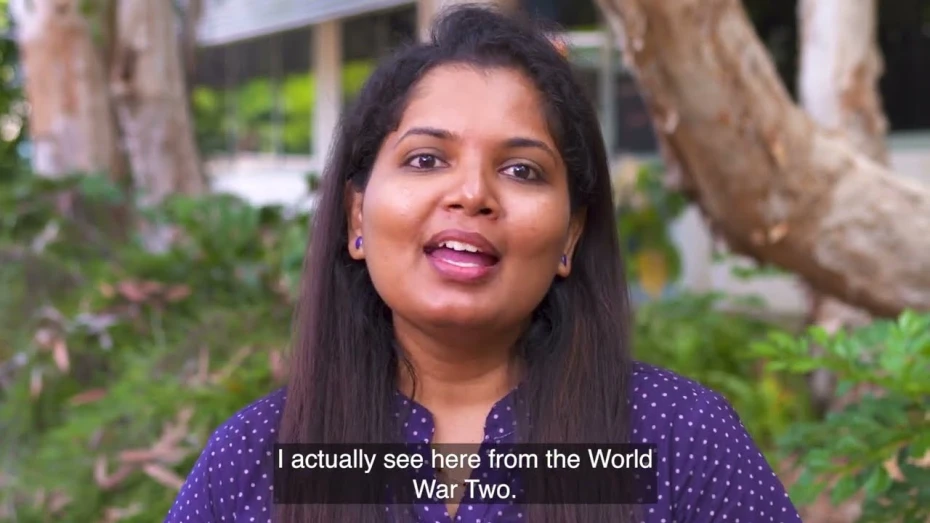
Learn about information technology at CDU
Kalyani is from India studying a Master of Information Technology (Information Systems and Data Science) at CDU. Hear more about her experience of studying, living, working and playing in Darwin, Northern Territory, Australia.
You make CDU
Together we are a positive force for change in our communities and the world.
Learn about information technology at CDU
Kalyani is from India studying a Master of Information Technology (Information Systems and Data Science) at CDU. Hear more about her experience of studying, living, working and playing in Darwin, Northern Territory, Australia.
How to apply
There are many ways to apply to CDU. The method you use depends on your course type, where you live and whether you are a new or returning student to CDU.
Remember to apply early for your best chance at securing an offer to study with us.
SATAC
SATAC is the application channel for residents of NT, ACT, SA, WA, QLD, VIC, NSW or TAS.
MyNextCourse
Direct applications are available to students who have completed a CDU or BIITE course at a Certificate III level or higher. Most CDU and BIITE enabling programs are also accepted through this process.
If you do not meet any of the criteria above please visit Pathways to study to view the options available to you.
Share this course