Student stories
From Foster Carer to Public Policy Change Maker

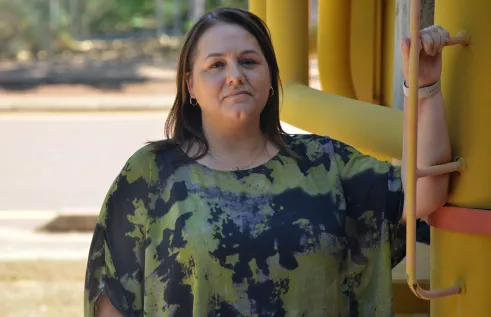
After more than a decade working on the frontline as a social worker, Jami-Lee Saxon knew one thing for certain: the people most affected by policy are rarely the ones writing it.
As a proud Aboriginal woman from Biripi Country, mother of two young children and member of a family deeply involved in foster care, she had seen firsthand how decisions made in offices can play out very differently in people's lives.
So when the opportunity arose to study a Master of Public Policy at Charles Darwin University (CDU), she didn't see it as a career change. She saw it as a chance to create change from the inside out.
"I wanted to make sure the reality on the ground was part of the conversation. You can write a policy that looks perfect on paper, but sometimes that's not how it works for people in real life."
A life shaped by caring for others
Jami-Lee's passion for helping people began long before she entered the workforce.
Growing up on the New South Wales Mid North Coast, her parents spent more than 20 years as foster carers, opening their home to children in need and eventually becoming legal guardians for several young people.
It was an experience that shaped the entire family.
"We saw a lot growing up," she says. "There were things that just didn't seem right, and even as a child you could see how much difference the right support could make."
Those experiences inspired Jami-Lee to pursue social work, eventually building a career with Services Australia where she has worked for more than 14 years.
But after becoming a mother herself, she began reflecting on what impact she wanted to have next.
"Coming back from maternity leave, I felt like I'd lost a little bit of myself," she says. "I knew I still had more to give and that there was something else I wanted to contribute."
That search for purpose led her to public policy.
The scholarship that changed everything
In 2024, Jami-Lee was awarded the Sir Roland Wilson Foundation’s prestigious Pat Turner Scholarship, enabling her to undertake postgraduate study while remaining connected to her role in the Australian Public Service.
Despite initially doubting whether she was the right candidate, she applied.
"I had a lot of self-doubt. Life became busy and I started wondering whether I’ve been out of the game too long."
Instead, she received a phone call almost immediately after applying. It was then that she realised this was exactly where she was supposed to be.
Why CDU was the right fit
The scholarship offered a choice between only two universities: CDU and ANU.
For Jami-Lee, the decision was easy.
"CDU aligned so strongly with my values. It felt like a place that understood different ways of learning and different ways of seeing the world."
Studying online from Port Macquarie while raising young children and supporting family members through significant challenges required flexibility.
Fortunately, CDU delivered exactly that. As life became increasingly busy, recorded lectures, accessible learning materials and supportive teaching staff allowed her to continue progressing through her degree.
"There were times when I was helping Dad during the day, putting the kids to bed at night and then studying until two in the morning. If the course hadn't been as flexible as it was, I don't think I could have done it."
Learning through lived experience
One of the aspects of CDU that stood out most was the encouragement to bring personal experiences and cultural perspectives into learning.
In one assignment, students were asked to create a map showing family and community connections.
Rather than using a conventional format, Jami-Lee drew inspiration from her father's Aboriginal artwork, deconstructing symbols, colours and storytelling elements to represent her own relationships and connections.
She was nervous about submitting something so different. Instead, she received overwhelmingly positive feedback.
"That was a really defining moment. It showed me that I didn't have to fit into a particular box. I could approach things in a way that felt authentic to me."
Throughout the degree, she also incorporated insights from social work, family life, caring responsibilities and community experiences into her assessments and research projects.
"I used my work, family and lived experience to strengthen my studies. Those things weren't barriers. They actually made my learning richer."
Support when it mattered most
Jami-Lee also credits CDU's teaching staff with helping her stay connected to her studies during particularly challenging periods.
One lecturer reached out for one-on-ones at the start of the subject.
"Kate Golebiowska made the effort to contact each student. It wasn't just about the coursework. She wanted to know how I was going, what I was interested in and how she could help me move forward."
That human connection reinforced something Jami-Lee believes sits at the heart of both education and public policy.
"People need to be seen as people."
Don't wait for the perfect time
As she nears graduation, Jami-Lee's advice for anyone considering further study is simple: don't wait.
"I spent a long time looking for the right time. But life is always going to throw curveballs."
Between raising children, supporting family members, balancing study and navigating unexpected challenges, she learned that progress doesn't require perfect conditions.
Instead, she discovered that life's experiences can become some of your greatest strengths.
"If something interests you, just start. Your work, your family and your lived experience can all enrich your study in ways you don't expect."
For Jami-Lee, studying public policy wasn't just about earning a qualification. It was about bringing together a lifetime of caring, learning and advocating for others and finding new ways to create meaningful change for the people who need it most.
Make a move towards the change you want to be in the world: study Public Policy at CDU

Related Articles
Seeking answers to low numbers of First Nations women in mining
CDU Researcher PhD candidate Jodi Cowdery investigates the low number of First Nations women working in the Northern Territory mining industry. The mining industry has long been populated by non-First Nations men from outside of the nearby communities.
Read more about Seeking answers to low numbers of First Nations women in mining
Are peace and democracy worth dying for?
We have all seen the images of war on our television screens. What happens when, inevitably, the guns fall silent and the blades are returned to their sheaths? When the red mist recedes, and some form of non-violent rationality raises its weary head above the bloodied parapets.
Read more about Are peace and democracy worth dying for?
Why an Arts degree is worth studying
Is an arts degree worth it? It’s a question you might be asking yourself as the Australian Government proposes to re-direct funding from Arts degrees to degrees in health, education, science and technology. It absolutely is, says Pro Vice-Chancellor Ruth Wallace.
Read more about Why an Arts degree is worth studying


