2026 Census to reveal how crises have reshaped Australian society, CDU expert says

The 2026 Census will provide a critical picture of how the COVID-19 pandemic, housing pressures and the rising cost of living have reshaped Australian society, according to a Charles Darwin University (CDU) demographer.
Since the last Census in 2021, Australians have experienced major social and economic disruption, including pandemic restrictions, rapidly rising housing costs, cost-of-living pressures and growing concerns about intergenerational inequality.
CDU Northern Institute demographer Professor Andrew Taylor said the Census would help reveal how these pressures had influenced where Australians live, how households are formed and whether people choose to have children.
“The Census gives us our most comprehensive picture of Australian society, including how and where we live, our relationships, our beliefs and the changing composition of our communities,” Professor Taylor said.
“It will help us understand how a particularly disruptive five years have affected Australians and whether those experiences have led to lasting social change.”
The Census is also one of the country’s most important sources of evidence for government planning, funding and policy development.
Professor Taylor said Census data was used by all levels of government to inform decisions about infrastructure, housing, health, education and community services.
“Population projections and many of the calculations that underpin public investment decisions use Census data as a baseline,” he said.
“The results will form the backbone of policy design, implementation and evaluation for the next five years and beyond.
“Just as elections and opinion polls provide an indication of people’s priorities, Census participation helps ensure the circumstances and needs of Australian communities are visible to policymakers.”
Professor Taylor said the Census was particularly valuable at a time when misinformation and political polarisation could undermine evidence-based public debate.
“In an environment of increasing misinformation, the Census provides a reliable statistical foundation for discussion about important national and local issues,” he said.
“That evidence improves our ability to design effective policies in areas such as housing, health, education and essential services.”

Building trust in the Census
Professor Taylor said concerns about privacy and data security could discourage some people from participating.
However, information provided to the Australian Bureau of Statistics is protected by law and identifiable Census information is not publicly released.
“The ABS has extensive safeguards in place to protect the confidentiality of Census responses,” Professor Taylor said.
“The information released through Census datasets is processed so individuals and households cannot be identified.
“With most Australians expected to complete the Census online, it is important people understand the security measures in place and feel confident participating.”
He said every response helped provide a more accurate picture of Australia.
“The Census gives communities and population groups a voice by making their circumstances visible,” Professor Taylor said.
“The more complete the Census is, the better governments can target policies, funding and services.”
Participation remains critical in the Northern Territory
Achieving strong participation will be particularly important in the Northern Territory, which recorded the country’s highest Census non-response rate in 2021.
CDU Master of Public Policy graduate La'aina Lavaka said awareness, accessibility and trust remained significant challenges in remote communities.
Mrs Lavaka said involving local people who understood the languages, culture and circumstances of each community would be essential to improving First Nations participation.
“One of the biggest challenges in remote areas is that people may not understand what the Census is or how the information will be used,” Mrs Lavaka said.
“First Nations communities can experience a constant stream of agencies, services and visitors, and the purpose of each interaction can become blurred.
“The Census is about much more than counting people. The challenge is clearly communicating why participation matters and how Census results influence the services and resources communities receive.”
Mrs Lavaka said locally led engagement could help build trust and ensure information was communicated clearly and appropriately.
“Local people understand the language, culture and community context,” she said.
“They are best placed to explain the importance of the Census and help ensure First Nations people can participate effectively.”
Mrs Lavaka is preparing to commence a PhD examining governance, culture and policy after completing CDU’s Master of Public Policy.
She said the degree strengthened her commitment to evidence-based policymaking and research that benefits Northern Territory communities.
“The course opened my eyes to the importance of evidence-based policy and helped me better understand how government decisions affect communities,” Mrs Lavaka said.
“My long-term goal is to continue working in policy research and evaluation, particularly in areas affecting First Nations and culturally diverse communities across the Northern Territory.”
To learn more about the Master of Public Policy visit Master of Public Policy (SPPOL2 - 2027) | Charles Darwin University
Aligned with the United Nations Sustainable Development Goals
Reduced inequalities
Goal 10
Reduce inequality within and among countries.
Related Articles
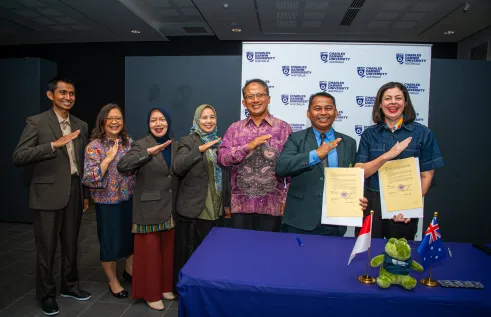
Partnership with Indonesian university to support education and research
A new partnership with one of East Java’s leading education institutions is aligning Charles Darwin University with priorities to strengthen Australia’s relationship with Indonesia.
Read more about Partnership with Indonesian university to support education and research
Darwin needs a BBL: Architecture student's vision for the Top End
A vertical promenade designed by a Charles Darwin University (CDU) architecture student and inspired by Singapore's Gardens by the Bay offers a glimpse into Darwin's future facelift.
Read more about Darwin needs a BBL: Architecture student's vision for the Top End
CDU improves standing in Times Higher Education rankings
Charles Darwin University (CDU) has improved its standing across all five categories in the 2027 Time Higher Education World University Rankings.
Read more about CDU improves standing in Times Higher Education rankings


