News
Australian education system failing to support critical reasoning in children, experts say

A Charles Darwin University (CDU) education expert warns that a narrow focus on standardised curriculum in education has reduced creative and critical reasoning skills in Australian students.
CDU Lecturer in Education Dr Stephen Bolaji said that the curriculum over the last decade had not addressed the Philosophy of Education, which he says was the bases of critical thought and reasoning.
“The critical thinking tools are a solid foundation to learn and should be a requirement in pre-service teacher training,” Dr Bolaji said.
“The critical thinking skills, like all other skills, need development.”
Dr Bolaji said this underdevelopment of critical reasoning skills has already had an impact.
“When young people interact with the world around them, they don’t have the critical reasoning skills to make up or evaluate a reasonable argument, so they just accept or reject ideas based on the face value of the information they are presented,” Dr Bolaji said.
“This lack of critical reasoning has contributed to the polarization of moral issues and politics. It has also created a social media environment that reinforces ideas and beliefs, rather than challenging them through meaningful debate.”
Dr Bolaji laid out his argument in the first chapter of the new book, African Education and Diaspora Studies, which collects research and critiques education patterns in Australia, Africa, and Asia.
The chapter, Where is Philosophy of Education in the Teacher Education Program in Australia?, was a perspective piece drawn from his 25 years of experience in education training in Australia and Africa.
“If you look at somewhere like New Zealand and the United Kingdom, then they have philosophy principles deeply embedded in their early education systems,” he said.
“It’s not the teacher’s fault here in Australia, the Philosophy of Education is just missing from the national curriculum.”
Dr Bolaji said the book came together from the weekly discussions and debates that a group of international education experts had to discuss their research.
“Exercises in critical thought and reasons led to the book’s development,” he said.
“What we discussed is that most education systems in developing and developed countries faced challenges, and these education challenges have impacted society.”
The book, African Education and Diaspora Studies, Is available from CDU Bookshop.
Related Articles
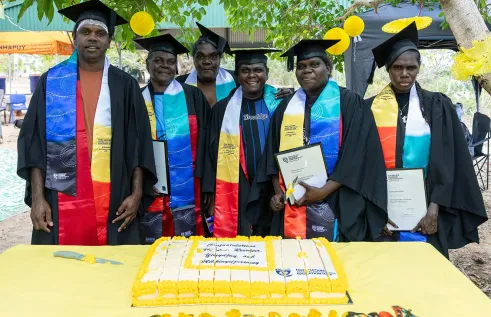
First Nations Training and Teacher Education Hub celebrates first major milestone
As Charles Darwin University's (CDU) First Nations Training and Teacher Education Hub draws closer to the end of its first year, one of its greatest milestones to date was conferring its first six graduates.
Read more about First Nations Training and Teacher Education Hub celebrates first major milestone
Federal funding for Country-based health and climate resilience
A new research collaboration to support and strengthen Country-based health and climate resilience has received funding through the National Health and Medical Research Council’s Centres of Research Excellence scheme.
Read more about Federal funding for Country-based health and climate resilience
New livestream brings remote Australian arid zone waterhole to the world
A new livestream from a remote waterhole in the Northern Territory is giving people around the world the opportunity to observe wildlife in real time.
Read more about New livestream brings remote Australian arid zone waterhole to the world


