News
Blue whales showing signs of malnutrition, a climate warning says CDU researcher
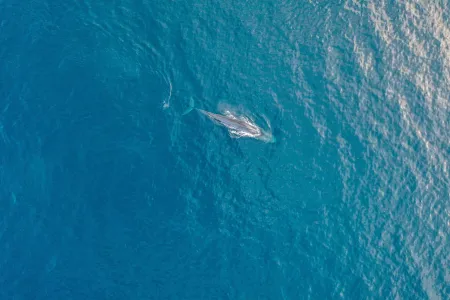
Blue whales that pass through the waters off Timor-Leste each year are showing signs of malnutrition according to a Charles Darwin University (CDU) researcher who has been studying the animals for almost a decade.
CDU’s Research Institute of the Environment and Livelihoods (RIEL) Adjunct Professor Karen Edyvane has monitored Pygmy Blue Whales passing through the 30km-wide Ombai-Wetar Strait, off the north coast of Timor-Leste en route to Australia and their feeding grounds in the Subantarctic waters.
Since 2016, studies have focused particularly on detailed monitoring of the whale migration through the narrow Ombai-Wetar Strait. As a part of this monitoring, researchers have been using drones to assess the overall health and condition of the whales by comparing their body shape to previous years.
This year United States Agency for International Development's (USAID) Tourism for All partnered with the project to promote sustainable whale tourism, education, and livelihoods of the communities in Timor-Leste.
Images and footage collected by Professor Edyvane's research team from whale migration season from September to December this year have shown that many whales are in poor health and are underweight in the lower body region and behind the blowhole.
“It’s quite normal for blue whales to lose weight during their time in tropical waters – but this year the whales looked very thin and underweight, particularly in the lower body and behind the blowhole,” Professor Edyvane said.
“In some animals, their ribs, vertebrae and backbones were very prominent and visible.”
Professor Edyvane said the animals showed a worrying decline in health this year with changes to their behaviour indicating high levels of stress.
“The whales not only departed their calving and breeding grounds (in Banda Sea, Indonesia) much earlier, but many appeared very malnourished,” she said.
“Rather than passing quickly and directly through the waters of Timor-Leste, we saw lots of prolonged, feeding behaviour by animals and the incredible targeting of small, highly-localised upwellings for food. They were clearly extremely hungry.”
Professor Edyvane said the oceanographic and climate evidence that pointed to the changes in the weight of the whales was compelling and could be due to rising sea temperatures.
“This year we observed record surface sea temperatures in the whale’s migratory route through Timor-Leste,” she said.
“We know that tropical seas in our region have warmed overall in recent decades due to changes in the climate drivers in our region, particularly the interannual El Nino-Southern Oscillation and the Indian Ocean Dipole and the intra-seasonal Madden-Julian Oscillation.
“We clearly need much more research that includes monitoring the blue whales and the tropical atmosphere and ocean changes much more closely to better understand the impact of these important climate trends.”
International Whaling Commission scientific committee vice-chair Dr Lindsay Porter first surveyed cetaceans in Timor-Leste in 2001 and said it was a special place.
“The whales pass within a kilometre of Timor-Leste's coastline, providing a unique opportunity to observe and identify these ocean-wandering giants as they navigate close to the shore,” Dr Porter said.
“Long-term studies are critical to the work of the Scientific Committee and the continuation of this work should be encouraged with the highest priority."
Researchers monitor the whale and dolphin numbers, movements, behaviours and health in Timor-Leste through a combination of drone work, animal observations, photo-identification, and boat and aerial surveys.
Professor Edyvane said in a partnership and citizen-science program, local whale tour operators also provide valuable whale images and drone footage to assist researchers. In 2020, the program also established a land-based whale spotting network of local fishermen.
Professor Edyvane said the deep waters of Timor-Leste were now a recognised global hotspot for whales and dolphins, with the program recording over 20 species in its waters, including migratory and endangered species, such as Pygmy Blue Whales and Sperm Whales.
The blue whale monitoring in Timor-Leste is part of a national whale monitoring program with the National University of Timor-Leste and partners, including the International Whaling Commission and Marine Tourism Association of Timor-Leste.
It is also part of a larger partnership program with CDU funded by USAID’s Tourism for All.
Related Articles

Federal funding for Country-based health and climate resilience
A new research collaboration to support and strengthen Country-based health and climate resilience has received funding through the National Health and Medical Research Council’s Centres of Research Excellence scheme.
Read more about Federal funding for Country-based health and climate resilience
New livestream brings remote Australian arid zone waterhole to the world
A new livestream from a remote waterhole in the Northern Territory is giving people around the world the opportunity to observe wildlife in real time.
Read more about New livestream brings remote Australian arid zone waterhole to the world
Leading scientist recognised for lifetime of dedication to Australian biodiversity and conservation
One of the nation’s most distinguished experts in Australian biodiversity and conservation will be celebrated in an upcoming Charles Darwin University graduation ceremony.
Read more about Leading scientist recognised for lifetime of dedication to Australian biodiversity and conservation


