NEWS ARTICLE
Calls for 'quantum shift' to Top End water management
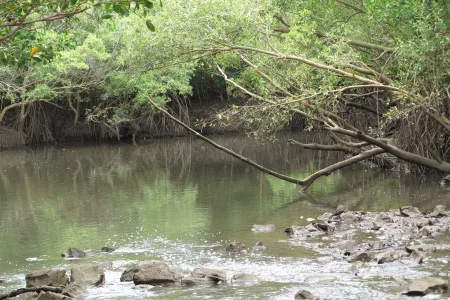
With still no signs of a monsoon in the Top End this wet season, industry, Indigenous, government and research groups met in Darwin this week to initiate what could be a paradigm shift to improve water systems management in the north.
Former Chief Minister Clare Martin AO opened the workshop and called for a quantum change to better manage water for health, sustainable development and Closing the Gap outcomes across northern Australia.
“Communities in the north are experiencing water shortages and insecurity, deteriorating water quality and increasing waterborne pathogen risks. This is stifling new development and in remote communities affecting people’s health,” Ms Martin said.
The groups attending the workshop agreed to progress a funding bid to establish a Cooperative Research Centre (CRC) to address these issues. The Water in Northern Australia (WiNA) CRC aims to:
- Improve surface and groundwater knowledge and tools to help manage water scarcity
- Improve community water systems to achieve better health outcomes and save water
- Facilitate Indigenous-led water quality and water systems solutions
- Re-design or upgrade overstretched, outdated and inappropriate waste-water systems
- Share solutions and foster knowledge exchange and partnerships.
Charles Darwin University, Power and Water Corporation, Menzies School of Health Research, Flinders University and the Department of Health have initiated the bid and are now seeking partners to make it a success.
Professor Karen Gibb from CDU’s Research Institute for the Environment and Livelihoods said solutions to these challenging issues could be found by working together - crossing disciplines and sectors and cultures - and by investing in robust, industry-led collaborative research.
“The programs and partnerships that we shape today and over the coming weeks will lay a foundation for the change we need,” Professor Gibb said.
She said a Bid Development Group had been established and members were keen to hear from interested parties via the Bid Coordinator (clare.taylor@cdu.edu.au).
Related Articles
New livestream brings remote Australian arid zone waterhole to the world
A new livestream from a remote waterhole in the Northern Territory is giving people around the world the opportunity to observe wildlife in real time.
Read more about New livestream brings remote Australian arid zone waterhole to the world
Leading scientist recognised for lifetime of dedication to Australian biodiversity and conservation
One of the nation’s most distinguished experts in Australian biodiversity and conservation will be celebrated in an upcoming Charles Darwin University graduation ceremony.
Read more about Leading scientist recognised for lifetime of dedication to Australian biodiversity and conservation
First Nations ranger knowledge reveals the threats facing NT’s green turtles
First Nations ranger groups working in protected areas such as national or marine parks identified illegal commercial fishing as a major concern for the Northern Territory’s green turtle populations, a study led by Charles Darwin University (CDU) and James Cook University (JCU) has found.
Read more about First Nations ranger knowledge reveals the threats facing NT’s green turtles


