CDU celebrates largest graduation in East Arnhem region yet
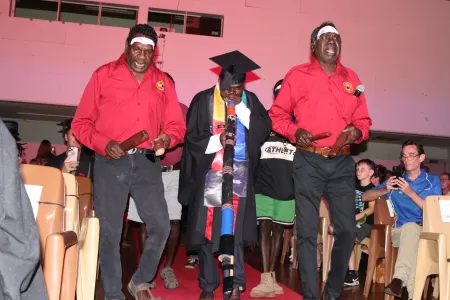
This year marks one of Charles Darwin University largest graduations in Nhulunbuy, with almost 100 students who graduated from the East Arnhem region.
The ceremony begun with a special academic procession that was led by a Buŋgul, a traditional Yolngu ceremonial dance and gathering, of local Traditional owners from Rirratjingu Aboriginal Corporation, the Buŋgul included members of the 2025 Graduating class.
Attendees also had the honour of hearing from Mayatili Marika who is a Yolŋu bilingual educator, curator and designer from the Rirratjingu Clan nation of Yirrkala in Northeast Arnhem Land.
Her work is guided by ancestral knowledge and the principle that art, identity, and connection to country and sea are inseparable. Her speech was woven with Yolŋu traditions and highlighted that education can strengthen culture and connection.
Master of Environmental Management graduate Yvette Douglas delivered the student address.
Yvette works as an Environmental Specialist in Nhulunbuy.
Yvette said that studying at CDU was the best choice she made for her educational journey as the university, staff and students truly understand what it’s like to live in Northern Australia.
“CDU understands Northern Australia. They understand the distance, the diversity, and the determination it takes to live and learn here,” she said.
“Our lecturers weren’t just experts; they were passionate, practical, and deeply connected to our region.
“They brought my lectures to life, linking theory to the landscapes, industries, and communities we call home.”
The ceremony celebrated the achievements of students from a range of backgrounds, and study areas including, Certificate I to Diplomas, Bachelors’ and Masters’ students.
CDU Vice- Chancellor Professor Scott Bowman said this graduation ceremony highlights the importance of the University’s presence in the region.
“Our remote students often have additional barriers when it comes to further education and training, by providing dedicated staff and spaces for them in the communities they live in, CDU is aiming to remove some of those barriers,” Professor Bowman said.
“These graduation ceremonies always solidify the fact that when people have access to education and support, our communities thrive.
“I am honoured to see so many people from this region be dedicated students and reach this significant milestone; we wish them every success wherever their journey takes them.”
Related Articles

Hamlet gets a contemporary twist in Darwin
Shakespeare’s most famous tragedy will be brought into the modern world in a bold new production of Hamlet at Charles Darwin University Theatre this month.
Read more about Hamlet gets a contemporary twist in Darwin
The good, the bad, and the ugly food: Why religious shoppers are buying bruised veggies
A recent study with Charles Darwin University examines how consumers’ religiosity influences the purchase of “ugly foods”, or foods that are aesthetically imperfect but nutritious.
Read more about The good, the bad, and the ugly food: Why religious shoppers are buying bruised veggies
Student Council President celebrates graduation, prepares to pass the torch to new team
After serving as the Charles Darwin University (CDU) Student Council President for two years, Shishtata Bhandari has graduated and is preparing to hand over the reins to the council's next leader.
Read more about Student Council President celebrates graduation, prepares to pass the torch to new team


