News Article
Drones to deliver health services
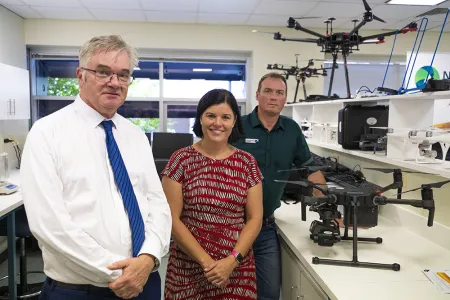
In a first for the Territory, drones will be used to deliver health care into remote communities across the NT.
The drones will expedite the delivery of time-critical medical items into hard to reach and seasonally inaccessible remote communities, helping save lives and reducing costs of delivery.
The Northern Territory Government is partnering with Charles Darwin University and iMOVE Australia to commission the drones.
iMOVE is the national centre for collaborative research and development in transport and mobility. It facilitates, supports and co-funds research projects that improve the way people and goods move in Australia.
Minister for Health, Natasha Fyles said the use of drones would be a game-changer when it comes to enhancing our healthcare system.
“It doesn’t matter whether you live in the city or in the bush – Territorians deserve to have access to the very best health services, and this new technology will be a driving force in this space,” she said.
“The Territory is on the front-foot to being a national leader in the development of drone technology for the carriage of health care.
“We also know this technology will open the door to new jobs and opportunities, as well as keeping Territorians in remote areas healthy and safe.”
Charles Darwin University Interim Vice-Chancellor Professor Mike Wilson said the team at CDU would investigate the potential in using automated aircraft for the delivery of time-critical medical items to remote communities across the Northern Territory.
“Drones are already being used in healthcare in developing countries, however, we need to undertake research to understand where they can reduce costs and improve health care outcomes for remote communities in the Northern Territory,” Professor Wilson said.
“This partnership is the first of its kind and will be a testing ground for the application of autonomous systems into health care delivery across Australia.”
The project will initially investigate the logistical challenges of using drone technology to deliver health services in the Territory, including:
- Procuring airframes that can manage the vast Australian distances, which are far greater than currently flown for health care carriage
- Adapting technology to withstand the Territory’s hot, humid and monsoonal climate
- Planning works with the Civil Aviation and Safety Authority to identify and regulate flight paths within current airspace requirements
- Integrating drones into the current health transport infrastructure network.
Related Articles
New livestream brings remote Australian arid zone waterhole to the world
A new livestream from a remote waterhole in the Northern Territory is giving people around the world the opportunity to observe wildlife in real time.
Read more about New livestream brings remote Australian arid zone waterhole to the world
Leading scientist recognised for lifetime of dedication to Australian biodiversity and conservation
One of the nation’s most distinguished experts in Australian biodiversity and conservation will be celebrated in an upcoming Charles Darwin University graduation ceremony.
Read more about Leading scientist recognised for lifetime of dedication to Australian biodiversity and conservation
First Nations ranger knowledge reveals the threats facing NT’s green turtles
First Nations ranger groups working in protected areas such as national or marine parks identified illegal commercial fishing as a major concern for the Northern Territory’s green turtle populations, a study led by Charles Darwin University (CDU) and James Cook University (JCU) has found.
Read more about First Nations ranger knowledge reveals the threats facing NT’s green turtles


