News
A challenging new world for wildlife: How humans have reshaped the food webs
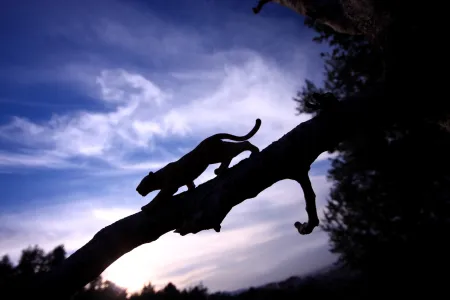
The relationship between predators and prey in the wild is underscored by an evolutionary arms race spanning millions of years, but new research has found modern human activity is reshaping the rules.
Led by Charles Sturt University (CSU) with support from Charles Darwin University and others, the review – published in one of the leading ecology and evolution journals – found that physical and behavioural traits of both predator and prey have been altered by human interference, and this has affected how they interact with each other.
The study examined the adaptations that different species evolved in response to human interaction such as fishing, climate change, species introductions, habitat alteration, or pollution.
For example, fisheries’ preference for harvesting larger fish has resulted in reduced body size and age structure in certain species, potentially increasing their vulnerability to predators.
Co-author Dr Chris Jolly, an adjunct for CDU’s Research Institute for the Environment and Livelihoods (RIEL) and Macquarie University Research Fellow, said these physical changes have flow-on effects for “who eats whom”.
“That matters because predator–prey interactions underpin the evolution of entire ecosystems,” Dr Jolly said.
“They influence everything from species abundance to vegetation and nutrient cycling – if we change how predators and prey interact, those effects can cascade through food webs and fundamentally alter ecosystems.”
Dr Jolly said one of the key takeaways from the study was that changes in animal behaviour and physiology weren’t always obvious or immediate, but could have long-term consequences.
“Trait shifts can build over time, leading to cascading effects like population declines, food web restructuring, or even local extinctions,” he said.
“The good news is that by understanding how human activities drive these changes, we can design better conservation strategies.
“Ultimately, this research highlights that conserving ecosystems means thinking not just about species, but about the dynamic relationships between them.”
Study lead author and CSU Postdoctoral Research Fellow, Dr Eamonn Wooster, said much of the work necessary to counteract the damage inflicted by human disruption was governed at a scale much higher than the individual.
But he said there were some “quick fixes” available at the individual level.
“The end of size selective hunting and fishing will help return natural variation to populations – trophy hunting is particularly damaging to animal populations.
“However, for other disturbances like climate change or urbanisation, preventing animals from responding to these rests on the prevention of the disturbance itself.
“Animals will continually adapt to the challenges humans present to them or in some cases, go extinct.
“Much of conservation in the Anthropocene is simply understanding the mess we created and how to help animals navigate it.”
Human-induced trait shifts reshape predator–prey interactions was published in the journal Trends in Ecology & Evolution.
Aligned with the United Nations Sustainable Development Goals
Responsible consumption and production
Goal 12
Ensure sustainable consumption and production patterns.
Life on land
Goal 15
Protect, restore and promote sustainable use of terrestrial ecosystems, sustainably manage forests, combat desertification, and halt and reverse land degradation and halt biodiversity loss.
Related Articles
Federal funding for Country-based health and climate resilience
A new research collaboration to support and strengthen Country-based health and climate resilience has received funding through the National Health and Medical Research Council’s Centres of Research Excellence scheme.
Read more about Federal funding for Country-based health and climate resilience
New livestream brings remote Australian arid zone waterhole to the world
A new livestream from a remote waterhole in the Northern Territory is giving people around the world the opportunity to observe wildlife in real time.
Read more about New livestream brings remote Australian arid zone waterhole to the world
Leading scientist recognised for lifetime of dedication to Australian biodiversity and conservation
One of the nation’s most distinguished experts in Australian biodiversity and conservation will be celebrated in an upcoming Charles Darwin University graduation ceremony.
Read more about Leading scientist recognised for lifetime of dedication to Australian biodiversity and conservation


