Experts warn clean energy transition must not come at cost of Indigenous rights
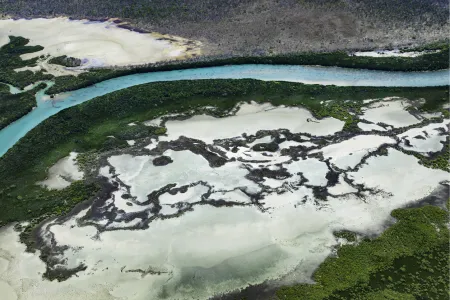
First Nations’ rights over Sea Country are being overlooked as Australia races into offshore gas and wind development, according to new research, with experts warning Traditional Owners remain excluded from decisions that threaten vital cultural, spiritual and economic connections.
According to a study in Heritage led by the Sea Country Alliance with Charles Darwin University (CDU), cultural rights at sea are far less recognised than those on land, creating a legislative gap that leaves Traditional Owners without a voice in offshore development.
Co-Chair of the Sea Country Alliance and the paper’s co-lead author, Rhetti Hoskins, said that without reform, offshore wind and gas risk becoming the next frontier of dispossession.
“For over 65,000 years Traditional Owners have cared for Sea Country, ensuring that the ecosystems thrived, and cultural connections remained strong," he said.
“Our connection to Sea Country is as important as it is to land, and yet, the protections that recognise our rights aren’t the same."
The research points to the Federal Court case Munkara v Santos (No 3) [2024], and illustrates the difficulties Traditional Owners face in safeguarding songlines, totems and other cultural heritage in the absence of free, prior and informed consent (FPIC).
The paper calls for urgent reforms to embed the United Nations Declaration on the Rights of Indigenous Peoples (UNDRIP) into offshore legislation and proposes a national Economic Empowerment Fund to ensure affected communities - including those in spill zones - share in the benefits.
Co-Chair of the Sea Country Alliance and the paper’s co-lead author, Gareth Ogilvie, said Australia must now step up as a global leader.
“Australia must not just meet but lead international best practice in approaching Sea Country as a holistic environment that includes cultural significance, plants and animals and minerals,” he said.
“Our Songlines connect the heart of Australia to the Australian coastline as it once was, now far out at sea - we understand Sea Country and terrestrial Country as one.”
CDU’s Asia Pacific School of Business and Law academic and the paper’s co-author, Matthew Storey, said Australia’s energy transition will be judged not only by its climate credentials but also by its justice credentials.
“Offshore energy development could either repeat the mistakes of past extraction regimes or set a global benchmark for Indigenous-led, culturally safe, and economically just energy development.”
Related Articles

Hamlet gets a contemporary twist in Darwin
Shakespeare’s most famous tragedy will be brought into the modern world in a bold new production of Hamlet at Charles Darwin University Theatre this month.
Read more about Hamlet gets a contemporary twist in Darwin
The good, the bad, and the ugly food: Why religious shoppers are buying bruised veggies
A recent study with Charles Darwin University examines how consumers’ religiosity influences the purchase of “ugly foods”, or foods that are aesthetically imperfect but nutritious.
Read more about The good, the bad, and the ugly food: Why religious shoppers are buying bruised veggies
Student Council President celebrates graduation, prepares to pass the torch to new team
After serving as the Charles Darwin University (CDU) Student Council President for two years, Shishtata Bhandari has graduated and is preparing to hand over the reins to the council's next leader.
Read more about Student Council President celebrates graduation, prepares to pass the torch to new team


