News
International students rate CDU highly on COVID-19 response
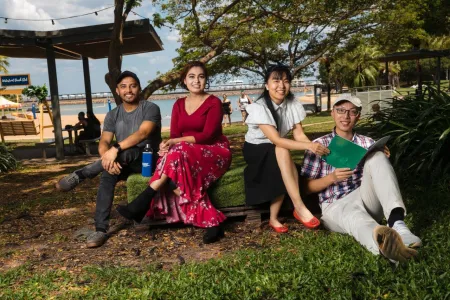
Recently published research investigated the impact of COVID-19 on international students studying in Australia and illustrated their favourable response to Charles Darwin University’s (CDU) COVID-19 interventions.
Academics from CDU’s Asia Pacific College of Business and Law (APCBL), Prof Steven Greenland, Dr Muhammad Saleem, Roopali Misra and Dr Bhanu Bhatia conducted the research during the second half of 2020.
The research team conducted an online survey among 159 APCBL international students and asked them to describe how COVID-19 had affected them and to rate the University’s response to COVID-19.
Prof Greenland said the Australian international education sector was among the hardest hit during the pandemic and much more academic research was needed to shed light on the effects of COVID-19.
“The international higher education sector has lost and will continue to lose billions of dollars. It’s therefore critical to understand COVID-19’s impact on international students and their changing behaviour,” Prof Greenland said.
“According to the survey, CDU did well in key intervention dimensions that related to supporting student wellbeing, promoting hygiene and social distancing, as well as effective communication and planning,” Dr Saleem said.
“But more was needed in providing financial support because many international students lost their jobs and family financial support, causing stress and mental health issues,” he said.
In addition to the survey, the researchers also collected qualitative data using in-depth interviews and focus groups with CDU international students.
“Through these interviews, we gained insights into how CDU compared to other universities and countries,” Dr Saleem said.
“Our results suggested CDU students were satisfied with the University’s COVID-19 support interventions and were recommending CDU to their friends studying elsewhere.”
According to Prof Greenland, Australia along with the UK, USA and Canada are the main international Higher Education markets.
“The countries that respond most effectively to COVID-19 stand to quickly gain competitive advantage,” he said.
In November 2020, CDU became the first and only Australian university to safely bring back international students on a charter flight. This achievement included effective quarantine support and significantly improved student satisfaction.
Maggie Law, CDU international student, said she was “very satisfied” with CDU’s COVID-19 intervention.
“I was one of the lucky students who successfully came to Darwin from the charter flight arranged by CDU. This historical success absolutely gives international students confidence and shows CDU is a university that always quickly responds to any changes in the COVID-19 situation,” she said.
Prof Greenland said international students’ choice of study destination had changed markedly since COVID-19.
“Australia could become the number-one destination if it continues to implement appropriate strategies for handling international students in the COVID-19 era,” he said.
“Now is the golden opportunity for Australia to recognise and respond to international students’ changing needs.”
Students’ study destination choices are influenced by a range of new priorities including the incidence of COVID-19, vaccination rates, COVID-19 support interventions, border closures and diplomatic relations.
“As illustrated, with its hard border closures, Australia is currently in a disadvantaged position, compared to UK which remains open” Prof Greenland said.
“It’s crystal clear that the universities and governments that respond and adapt to international students changing selection criteria will be the most successful in the long run.”
The recent study focused on support interventions and the research report can be found here: tandfonline.com/doi/full/10.1080/08841241.2021.1949660
Related Articles
Partnership with Indonesian university to support education and research
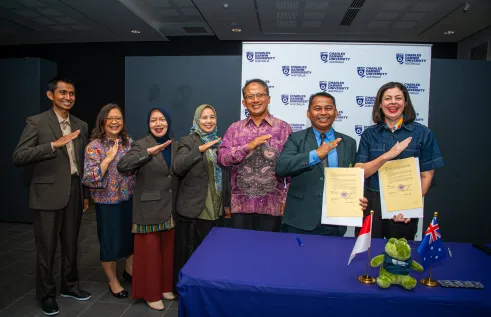
A new partnership with one of East Java’s leading education institutions is aligning Charles Darwin University with priorities to strengthen Australia’s relationship with Indonesia.
Read more about Partnership with Indonesian university to support education and research
Australia ranked among world's top countries for quality of life
Australia is one of the world's best countries for overall quality of life, according to an international study into what truly drives well-being.
Read more about Australia ranked among world's top countries for quality of life
CDU awards Timor-Leste President with Honorary Doctorate
Charles Darwin University (CDU) has awarded the President of the Democratic Republic of Timor-Leste and Nobel Peace Laureate, José Ramos-Horta, a Doctor of Letters (honoris causa).
Read more about CDU awards Timor-Leste President with Honorary Doctorate


