News
Killed, eaten, disappearing: 2.6 billion reasons for better fox and cat control
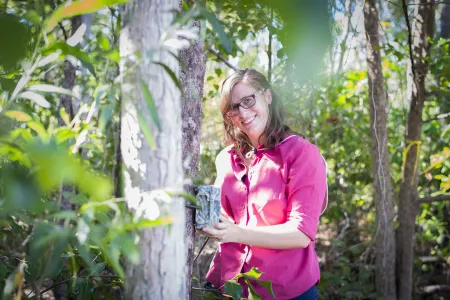
Scientists are calling for better management of cats and foxes as a new national study led by Charles Darwin University (CDU), finds that 697 million reptiles, 510 million birds and 1.4 billion mammals are being killed by cats and foxes each year across Australia.
Charles Darwin University (CDU) Adjunct Researcher and lead author of the study Dr Alyson Stobo-Wilson said this research just published in the conservation journal Diversity and Distributions, gives conservation managers valuable insights to guide responses to these two introduced predators.
“We already had good information about the cats’ impact on other species. This research gave us a clearer picture on the impact of both species nationally and in different and more remote environments,” Dr Stobo-Wilson said.
The study was undertaken by a team of 23 scientists from 16 universities and conservation agencies and is underpinned by over 50,000 poo and stomach samples and hundreds of densities counts for cats and foxes across the country.
The research coordinated by the Threatened Species Recovery Hub of the Australian Government’s National Environmental Science Program has calculated for the first time the total number of mammals, birds and reptiles killed by foxes and cats in Australia each year.
Dr Stobo-Wilson said that without a major increase in the amount and effectiveness of cat and fox control in Australia, these predators would continue to take a heavy toll on many species which are often also struggling from other threats such as habitat loss.
“Feral animal density is very important to understand the impact of foxes and cats in different environments,” she said.
There are an estimated 1.7 million foxes in Australia. They occur across 80 per cent of the country, being absent from only Tasmania and the monsoonal tropics. As a part of the study, it was found that foxes have been recorded killing 350 species of Australian native mammals, reptiles and birds.
“We found that fox densities and impacts are highest in temperate southern mainland Australia. In temperate forests they collectively kill at least 1000 animals per square kilometre per year,” she said.
The project’s senior scientist Professor John Woinarski from Charles Darwin University’s Research Institute for the Environment and Livelihoods said that the findings highlight that targeted and integrated management of both foxes and cats is essential to conserving Australian wildlife.
“Since foxes and cats were introduced to Australia by Europeans, they have played a major role in the declines and extinctions of many native animals,” Professor Woinarski said.
“To be effective management programs need to be highly strategic as numbers of both of these predators can rebound quickly when management is not on-going or is piecemeal across a landscape.
Co-author Professor Trish Fleming, Director of the Centre for Terrestrial Ecosystem Science and Sustainability at Murdoch’s Harry Butler Institute said that the research gives us 2.5 billion reasons to undertake more effective fox and cat control.
“While some areas of Australia benefit from broad-scale baiting of foxes and similar control measures for cats, most of Australia has no effective management practices in place and so the impacts on biodiversity are likely to be severe, widespread and ongoing,” Professor Fleming said.
Professor Fleming said foxes took a heavy toll on forest animals like possums and gliders, but cats were more numerous so had a wider diet than included more than 700 species of native mammals, reptiles and birds.
The study also found the highest toll by cats is around urban areas where the number of animals killed per square kilometre per year is 5670 killed by feral cats and 13100 by pet cats.
Related Articles
'Desert Rose' to be preserved
The legacy of a world record-breaking solar car, developed by and raced by Charles Darwin University students and staff, will be preserved and celebrated in the Northern Territory’s premier museum.
Read more about 'Desert Rose' to be preserved
Federal funding for Country-based health and climate resilience
A new research collaboration to support and strengthen Country-based health and climate resilience has received funding through the National Health and Medical Research Council’s Centres of Research Excellence scheme.
Read more about Federal funding for Country-based health and climate resilience
New livestream brings remote Australian arid zone waterhole to the world
A new livestream from a remote waterhole in the Northern Territory is giving people around the world the opportunity to observe wildlife in real time.
Read more about New livestream brings remote Australian arid zone waterhole to the world


