New drone program awarded Federal funding
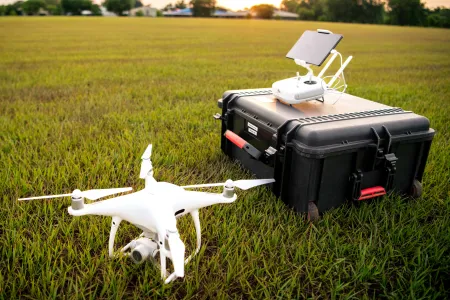
Students from across the Northern Territory will have the chance to learn the ins and outs of the NT drone industry after a Charles Darwin University (CDU) program received Federal Government funding.
The CDU Drone program was awarded $99,020 through The Maker Projects: Community STEM Engagement Grants 2022.
The program, in partnership with National Drones, will provide a pathway into Science, Technology, Engineering and Mathematics (STEM) careers for Northern Territory youths in years 9 to 12, including the option to achieve a nationally recognised/accredited Vocational Education and Training qualification.
The CDU Drone program coordinator Dr Rebecca Rogers said students would be introduced to different aspects of the Territory’s unique drone industry and learn how to use the technology to solve real-world problems.
“We really want the program to highlight existing challenges that are unique to the Northern Territory and the drone pilots trying to solve them,” Dr Rogers said.
“This means students might explore how drones can detect feral pigs or monitor endangered wallabies, deliver health services or even look for rock art.
Dr Rogers said students would be able to learn different aspects of drones such as flying, safety and the legalities of operating the technology.
She said the program would open students’ minds to the opportunities they can seize to drive change in the Territory.
CDU Professor Hamish Campbell, who is the Director of the North Australia Centre for Autonomous Systems (NACAS) based at CDU, said in the future drone technologies would be everywhere.
“We find young people have a natural affinity with the technology, and this program will give Northern Territory youth a leg up from which they can become leaders in the field,” Professor Campbell said.
“Drones could make a real difference to people in the Northern Territory, but beyond that they are a great tool for learning the skills needed to be successful in all kinds of STEM careers,” Dr Rogers said.
The program will be offered in schools, festivals and remote communities from later this year and will give students a critical bridge into a Certificate III qualification and other STEM courses.
Related Articles
New livestream brings remote Australian arid zone waterhole to the world
A new livestream from a remote waterhole in the Northern Territory is giving people around the world the opportunity to observe wildlife in real time.
Read more about New livestream brings remote Australian arid zone waterhole to the world
Leading scientist recognised for lifetime of dedication to Australian biodiversity and conservation
One of the nation’s most distinguished experts in Australian biodiversity and conservation will be celebrated in an upcoming Charles Darwin University graduation ceremony.
Read more about Leading scientist recognised for lifetime of dedication to Australian biodiversity and conservation
First Nations ranger knowledge reveals the threats facing NT’s green turtles
First Nations ranger groups working in protected areas such as national or marine parks identified illegal commercial fishing as a major concern for the Northern Territory’s green turtle populations, a study led by Charles Darwin University (CDU) and James Cook University (JCU) has found.
Read more about First Nations ranger knowledge reveals the threats facing NT’s green turtles


