News
New technology to support researcher analysis
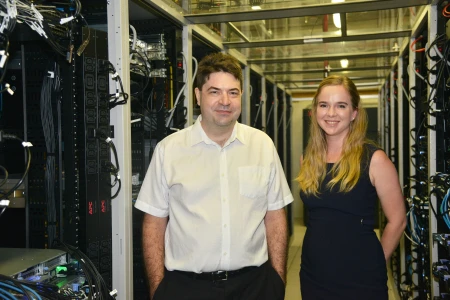
Charles Darwin University (CDU) and Menzies have acquired a new High-Performance Computer (HPC) to support research and academic tasks that require rapid computations.
The $300,000 investment in the new High-Performance Computer (HPC) delivers new computing capabilities that will be used by researchers undertaking calculations with improved computing power.
High-Performance Computing is the practice of using parallel data processing to improve computing performance and complex calculations.
HPC systems are able to perform quadrillions of calculations per second, compared to regular laptops or desktops.
The computer has been named Ada, after Ada Lovelace, often regarded as the first computer programmer.
CDU Head of Laboratory Science and Menzies Professor of Medical Laboratory Science Phil Giffard said the main use of the HPC would support the major research areas of Menzies and CDU in computerised genetics.
“Having this kind of computational power on-site presents an advantage, and means issues around data transmission are enhanced, and file transfers of large files and analyses can be completed faster and more efficiently,” Professor Giffard said.
“There are some tasks where the requirements for large files and the volume of calculations is too high, so therefore this is a dedicated facility for computational tasks that are beyond what a normal office computer can do. “
CDU PVC Research and Innovation Dr Steve Rogers said the HPC would provide a computational uplift for researchers in the CDU and Menzies research community.
“This investment by CDU and Menzies is building the quality and excellence of our research by providing this cutting-edge computational infrastructure for our researchers,” Professor Rogers said.
The computer is available for all researchers at CDU and Menzies to use, but access must be requested, and training will be provided. It is managed by Menzies Bioinformatician and High-Performance Computing Support Officer Mariana Barnes.
Related Articles

Federal funding for Country-based health and climate resilience
A new research collaboration to support and strengthen Country-based health and climate resilience has received funding through the National Health and Medical Research Council’s Centres of Research Excellence scheme.
Read more about Federal funding for Country-based health and climate resilience
New livestream brings remote Australian arid zone waterhole to the world
A new livestream from a remote waterhole in the Northern Territory is giving people around the world the opportunity to observe wildlife in real time.
Read more about New livestream brings remote Australian arid zone waterhole to the world
How ants are cashing in on the fight against money laundering
An AI model inspired by ants, bees, and birds could be the key to cracking down on blockchain-based money laundering, new research led by Charles Darwin University (CDU) has found.
Read more about How ants are cashing in on the fight against money laundering


