News
North Australia reefs vital for connectivity between coral ecosystems, but how vital still a mystery
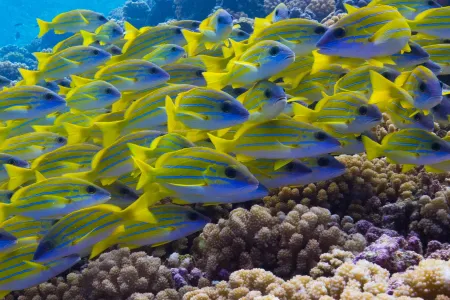
A new study from a team of international researchers that shows how global reef ecosystems are connected, has also exposed how little is known about the vital coral reefs across Northern Australia, according to a Charles Darwin University researcher.
The landmark study published in the journal, Science last week, identified the distinct and complementary role that each reef system plays in the ecosystem as a sink, source, or dispersal corridor for fish larvae across the globe.
CDU’s Research Institute for the Environment and Livelihoods postdoctoral researcher and co-author of the study Dr Osmar Luiz said that most of the reefs included in the analysis across Northern Australia were sources of fish larvae for other reef systems.
“But there is a lot we don’t know about reefs in the Northern Territory. Ï know there is a lot of vital reef ecosystems across Northern Australia that has not been identified or surveyed,” Dr Luiz said.
“Not a lot of scuba divers want to get into the water on Northern Territory reefs to do the surveying, but now we have remote technology to do it.”
Dr Luiz said the last time there was any surveying of coral systems in the Northern Territory was in the 1990s.
“We don’t even have a list of endangered coral species,” he said.
“But the reef systems in Queensland and Western Australia are well documented.”
The team, led by Dr Luisa Fontoura, a postdoctoral researcher from Macquarie University’s School of Natural Sciences, modelled larval dispersal across coral reefs around the world by combining ocean current movement and the biological characteristics of larvae.
Even though the methods have been widely used to study ecology and conservation, this study was the first to simulate coral reef connectivity such a large but detailed scale while grouping fish into four distinct life cycles, such as species that breed multiple times a year and those that breed once a year.
The authors identified coral reefs that serve as dispersal corridors, reefs that retain larval subsidies, or larval sinks, and reefs that export larvae or larval sources.
Most of the reefs across Northern Australia in the study were classified as source reefs, which means larvae from Northern Australia was replenishing reefs in other parts of the world through dispersal corridors.
Most of this dispersal was to areas around Timor Sea and vital reef archipelagos in South East Asia. But is also important for self-replenish our own reefs.
“The Northern Australia reefs we do know about are sources for reef fish larvae. There are not many (larvae) sinks, so they are critical to be preserved to maintain a healthy global coral ecosystem,” he said.
According to the study, 70 per cent of the coral reefs that are vital to the connectivity of coral reefs across the globe are not protected.
See interactive map on source sink dynamics on coral reefs worldwide: https://bit.ly/3IcTSxY
Related Articles

Federal funding for Country-based health and climate resilience
A new research collaboration to support and strengthen Country-based health and climate resilience has received funding through the National Health and Medical Research Council’s Centres of Research Excellence scheme.
Read more about Federal funding for Country-based health and climate resilience
New livestream brings remote Australian arid zone waterhole to the world
A new livestream from a remote waterhole in the Northern Territory is giving people around the world the opportunity to observe wildlife in real time.
Read more about New livestream brings remote Australian arid zone waterhole to the world
Leading scientist recognised for lifetime of dedication to Australian biodiversity and conservation
One of the nation’s most distinguished experts in Australian biodiversity and conservation will be celebrated in an upcoming Charles Darwin University graduation ceremony.
Read more about Leading scientist recognised for lifetime of dedication to Australian biodiversity and conservation


