Australia ranked among world's top countries for quality of life

Australia is one of the world's best countries for overall quality of life, according to an international study into what truly drives well-being.
The global study led by Charles Darwin University (CDU) and Griffith University analysed data from 48 countries across more than 20 years to examine how well-being has evolved and what factors matter most for people's quality of life.
Each country was examined through the Multidimensional Well-Being Index (MDWI), a new comprehensive measure of wellbeing which includes health, finance, social capital, safety and more.
This measure used data from the World Values Survey (WVS), an international research project studying changing values and their impact on society.
The results show that health and access to quality healthcare are the strongest drivers of wellbeing globally, followed by social capital or the value of positive human connections.
Of the countries examined – 28 developing and 20 developed – the regions enjoying the greatest wellbeing are the Netherlands, Singapore and Australia, with MDWI values of >0.70.
The lowest ranked countries are Peru and Iran, with MDWI values of <0.50.
Lead author and CDU Lecturer in Economics and Business Dr Mohammad Rajib Hasan said the index could be used to support more targeted and effective policy decisions.
“Wellbeing is not just about economic growth. It is about people’s health, their relationships, and the strength of the communities they live in,” Dr Hasan said.
“If we understand what truly drives well-being in a country, we can design smarter policies - whether that means investing in healthcare, strengthening communities, or improving governance.”
In Australia, according to the MDWI values, social capital was recorded as the biggest contributor to wellbeing in 2009 but has since been overtaken by health.
“This implies that people in Australia are enjoying better healthcare facilities,” Dr Hasan said.
"But the downturn of social capital is alarming. It means there is a decline in social and institutional trust across Australia, and we need to work more on improving these aspects.”
Tasmania, Queensland and the Northern Territory had the lowest levels of wellbeing compared to other jurisdictions, with health remaining as the single strongest contributor to wellbeing.
The study was conducted alongside CDU Pro Vice-Chancellor for the Faculty of Arts and Society Professor Maneka Jayasinghe, and Griffith University Professor of Econometrics Professor Eliyathamby Selvanathan.
Intertemporal analysis of well-being and its contributing factors: Cross-country evidence was published in the International Journal of Wellbeing.
Aligned with the United Nations Sustainable Development Goals
Good health and well-being
Goal 3
Ensure healthy lives and promote well-being for all at all ages.
Related Articles
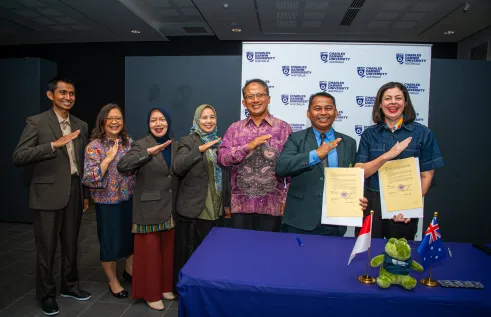
Partnership with Indonesian university to support education and research
A new partnership with one of East Java’s leading education institutions is aligning Charles Darwin University with priorities to strengthen Australia’s relationship with Indonesia.
Read more about Partnership with Indonesian university to support education and research
Crocheted landscape takes the gold in architecture competition
When tasked to defy growing reliance on artificial intelligence and create a landscape model without digital tools, Charles Darwin University (CDU) Bachelor of Architectural Design student Jorja Handebo turned to her hobby of the past five years: crochet.
Read more about Crocheted landscape takes the gold in architecture competition
First Nations Training and Teacher Education Hub celebrates first major milestone
As Charles Darwin University's (CDU) First Nations Training and Teacher Education Hub draws closer to the end of its first year, one of its greatest milestones to date was conferring its first six graduates.
Read more about First Nations Training and Teacher Education Hub celebrates first major milestone


