News
Prime time for drones on feral pig watch in NT
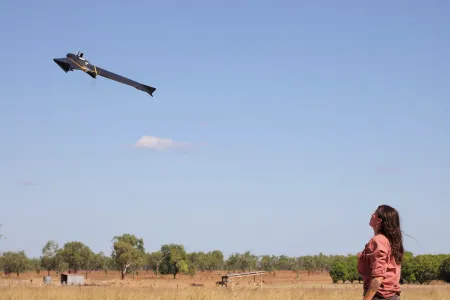
A Charles Darwin University (CDU) study has identified early evening, or a wet season morning, as the prime time for surveying feral pigs from sky-high drones, which could help land rangers to improve management of the stealthy and invasive animals.
The study combined aerial drone surveying with GPS tracking to account for variations between the data, evaluating the time and environmental factors influencing detection and population estimates.
CDU North Australian Centre for Autonomous Systems (NACAS) Director, Professor Hamish Campbell said drones are a great tool for monitoring wildlife but they have their own limitations, so studies like this can help get the best conservation outcomes.
“Aerial drone systems are now widely used to survey wildlife, but validation in the detectability of individuals is rarely assessed,” Professor Campbell said.
“Monitoring is a critical part of the success of any management program and data from studies like this ensure that we are creating robust and cost-effective programs."
The researchers released wild-caught feral pigs into a large natural habitat enclosure in northern Australia.
Using a fixed-wing drone equipped with dual thermal infrared and visible imaging sensor cameras, the team conducted multiple flights over the study area during both wet and dry seasons, from sunrise to sunset.
Detection probability was at its lowest during mid-afternoon, while the early evening had the highest detection probability of 50 to 75 per cent.
CDU PhD candidate Aliesha Hvala said the study found that the probability that a pig was visible in aerial imagery was highly variable.
“We observed seasonal differences, with detection probabilities exceeding 50 per cent in the mornings of the wet season, in contrast to less than 30 per cent during the dry season,” Ms Hvala said.
“GPS location data also enabled us to assess how canopy cover, land cover, and ambient temperature altered animal detection probability.”
NACAS researcher Dr Rebecca Rogers said the findings could help enhance the accuracy of population assessments and contribute to more effective wildlife management and conservation.
"Resources are often limited for wildlife management, so being able to target monitoring efforts will lead to better conservation outcomes,” Professor Rogers said.
The paper titled ‘Supplementing aerial drone surveys with biotelemetry data validates wildlife detection probabilities’ was published in Frontiers journal.
Related Articles
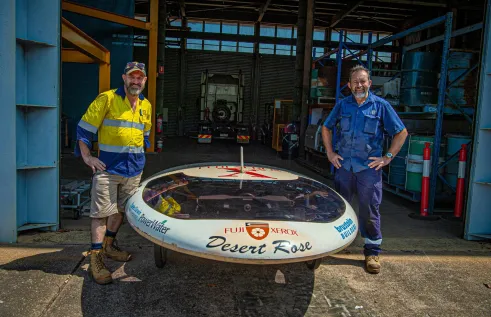
'Desert Rose' to be preserved
The legacy of a world record-breaking solar car, developed by and raced by Charles Darwin University students and staff, will be preserved and celebrated in the Northern Territory’s premier museum.
Read more about 'Desert Rose' to be preserved
Federal funding for Country-based health and climate resilience
A new research collaboration to support and strengthen Country-based health and climate resilience has received funding through the National Health and Medical Research Council’s Centres of Research Excellence scheme.
Read more about Federal funding for Country-based health and climate resilience
New livestream brings remote Australian arid zone waterhole to the world
A new livestream from a remote waterhole in the Northern Territory is giving people around the world the opportunity to observe wildlife in real time.
Read more about New livestream brings remote Australian arid zone waterhole to the world


