NEWS ARTICLE
Printing tomorrow’s potential today
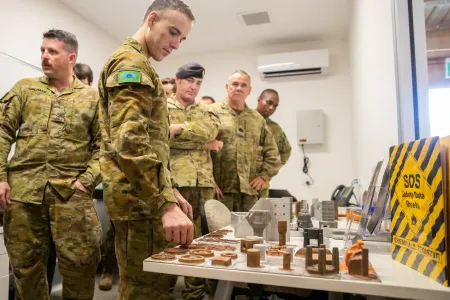
On the spot design and manufacturing through new cutting-edge metal 3D Printing technology will soon enhance lines of logistics for the Australian Army.
The Australian Army has kicked off a 12-month pilot trial of the new technology in partnership with SPEE3D and Charles Darwin University (CDU).
The $1.5 million venture recently announced by the Minister for Defence Industry, the Hon Melissa Price MP, will see 20 Darwin-based soldiers trained in advanced additive manufacturing.
The soldiers, who are mostly drawn from 1st Combat Service Support Battalion (1 CSSB), will be taught how to design and print parts using the WarpSPEE3D 3D metal printer.
The trial represents the realisation of a 1 CSSB proposal to Army in 2019, to modernise and enhance the resilience of the ADF’s supply chains.
Commanding Officer 1 CSSB, Lieutenant Colonel Kane Wright, said that the initiative demonstrates how Army is keeping up with the accelerated nature of warfare.
“This partnership with CDU and SPEE3D shows that we as an army are looking to the future and embracing advanced technologies to speed up our processes,” Lieutenant Colonel Wright said.
“At maturity we see it becoming an essential enabler that will redefine how logistics is employed to support our dependencies on the future battlefield.”
Lieutenant Colonel Wright explained that the printer harnesses the power of kinetic energy to fabricate parts in a safe and environmentally friendly manner, allowing 3D metal printing in the field.
“This will reduce the requirement to deploy with bulky holdings of multiple repair parts, hence increasing mobility and survivability and reducing time waiting for new parts to create greater resilience in the supply chain,” he said.
The initial training will be delivered at CDU’s Casuarina Campus by experienced researchers over a 10-week period.
Weekly sessions will cover everything from the fundamentals of design, 3D modelling, and printing, to the testing and evaluation of developed parts.
Lieutenant Colonel Wright said that the Army will begin by trialling the production of non-safety critical repair parts while leaning on the industry experts to explore the full potential of the capability.
CDU Vice-Chancellor and President, Professor Simon Maddocks, visited the soldiers in the class-room.
“This 3D printing technology has the potential to change the way many industries, including Defence, design, manufacture and supply parts,” Vice-Chancellor Maddocks said.
“CDU has become a centre of excellence in exploring and applying this new technology and we’re pleased to have such eager professional soldiers join us to learn this new skill set.”
Among the 20 Darwin-based soldiers, 1 CSSB Fitter Lance Corporal Sean Barton was quick to volunteer for the trial.
“This is a very exciting opportunity for me and very different from my regular trade as a Fitter,” Lance Corporal Barton said.
“I am looking forward to getting my hands on the software, learning about the design process and being one of the first to learn how to use the technology – it’s pretty cool,” he said.
The Royal Australian Navy launched a similar Trial in November 2019 together with SPEE3D and CDU, to streamline the maintenance of patrol vessels.
Related Articles
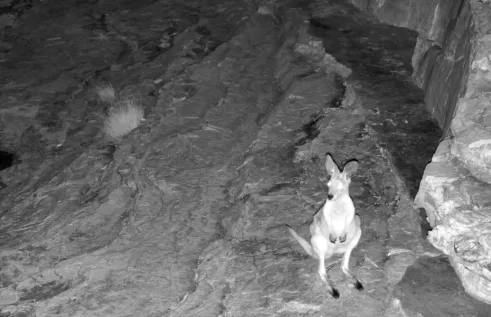
New livestream brings remote Australian arid zone waterhole to the world
A new livestream from a remote waterhole in the Northern Territory is giving people around the world the opportunity to observe wildlife in real time.
Read more about New livestream brings remote Australian arid zone waterhole to the world
Leading scientist recognised for lifetime of dedication to Australian biodiversity and conservation
One of the nation’s most distinguished experts in Australian biodiversity and conservation will be celebrated in an upcoming Charles Darwin University graduation ceremony.
Read more about Leading scientist recognised for lifetime of dedication to Australian biodiversity and conservation
New construction management course to bolster NT’s building industry
A new Master of Construction Management from Charles Darwin University (CDU) is set to bolster the Northern Territory’s building industry.
Read more about New construction management course to bolster NT’s building industry


