News
Rain, hail or shine, this CDU technician has a tower to climb
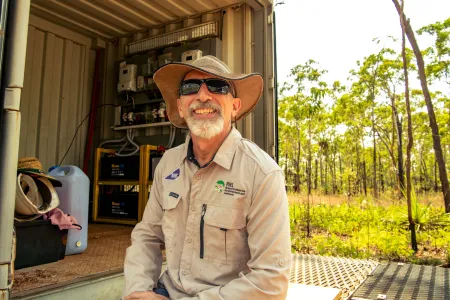
For nearly 15 years, Charles Darwin University’s (CDU) Matthew Northwood has scrambled up towers in remote corners of the Northern Territory to test, adjust and repair technical equipment that’s providing vital information about a changing climate and impacts on our NT environment.
In a global study taking place at around 600 sites across the world, earth systems researchers are measuring ecosystem fluctuations in carbon, water vapour, wind, and vegetation to inform and better understand trends in climate and greenhouse gases, as well as predict future risks.
According to the ARC Centre of Excellence for Climate Extremes, Australia ranks 98 in the top 100 hottest countries in the world, but is the only one to provide scientific observations about its climate, with the previous 97 countries lacking the infrastructure to support monitoring towers or research.
Mr Northwood said the data collected from the hot environments of the NT is “invaluable” for creating and evaluating land and climate models needed for predicting future rates of vegetation carbon uptake and loss, water use, droughts and heatwaves.
“These flux towers all measure environmental changes in hot savanna ecosystems, and we have the equivalent of about 90 years’ worth of data,” Mr Northwood said.
“We are currently monitoring five towers across a 1000 mm rainfall gradient in the NT, from Howard Springs, Litchfield National Park to Elliot in both natural and agricultural systems.”
CDU has a long history of taking measurements of the lower atmosphere with flux towers.
CDU Research Institute for Environment and Livelihoods environmental scientist Professor Lindsay Hutley and friends first started roaming the Stuart Hwy making campaign measurements from the back of an old Toyota Landcruiser Troopcarrier back in 1997.
Today, the five towers in the Top End and Big Rivers region managed by CDU and two tower sites in Central Australia managed by James Cook University are all recognised as National Research Infrastructure under the NCRIS-enabled Terrestrial Ecosystem Research Network (TERN) project.
The tower site within Litchfield National Park, (Litchfield Savanna SuperSite) is the premier site within the CDU network. Operational since 2015, the SuperSite is one of 16 similar key sites dotted across Australia monitoring important ecosystems.
“This data provides a unique insight into how the climate is warming not just in Australia, but in similar high temperature savanna environments around the world, so we can get an idea of what to expect with future climate change,” Mr Northwood said.
TERN monitoring SuperSites are the hot spots of numerous collaborations with national and international researchers, ranging from NT tech company maitec (Dr Stefan Maier), CSIRO, The University of Western Australia, Queensland University of Technology, to the European Space Agency (ESA) and NASA.
“The Savanna SuperSite allows us to calibrate a model of what the vegetation is doing in terms of respiration and CO2,” he said.
“That information validates satellite operations and equipment used by the ESA and NASA to remotely detect CO2 emissions and ecosystem stress.”
There are around 30 additional tower sites that make up the Australian branch (OzFlux) of the international FLUXNET network, the collective of earth system monitoring sites that are all using the same method to measure gas exchange between different ecosystems and the atmosphere.
“In the NT, the sites are also linked to one of TERN’s other platforms, Ecosystem Surveillance, which monitors vegetation and soil condition across a national network of plots and transects vegetation.”
Key to the project is that measurements are taken consistently, and equipment is reliable.
Sounds simple, but in the real world, power supplies fail, wildfires burn out sites, modems get destroyed by lightning, trees fall onto guy wires, and ants use the internal workings of dataloggers as ideal nesting sites.
On the flip side, CDU’s supportive long-term partners at The University of Western Australia, (Professor Jason Beringer, Caitlin Moore, and Storm Findlay-Cooper) and the TERN Ecosystem Processes team provide the collaboration necessary to succeed.
“The thing I most enjoy is the diversity of my job – I’m climbing above the canopy to adjust sensors one day to collaborating with CDU TAFE staff in metal fabrication for this and other projects in RIEL. Every day is different!”
CDU is conducting a number of studies including terrestrial carbon transfer into aquatic ecosystems at the Savanna SuperSite.
Related Articles
Federal funding for Country-based health and climate resilience
A new research collaboration to support and strengthen Country-based health and climate resilience has received funding through the National Health and Medical Research Council’s Centres of Research Excellence scheme.
Read more about Federal funding for Country-based health and climate resilience
New livestream brings remote Australian arid zone waterhole to the world
A new livestream from a remote waterhole in the Northern Territory is giving people around the world the opportunity to observe wildlife in real time.
Read more about New livestream brings remote Australian arid zone waterhole to the world
Leading scientist recognised for lifetime of dedication to Australian biodiversity and conservation
One of the nation’s most distinguished experts in Australian biodiversity and conservation will be celebrated in an upcoming Charles Darwin University graduation ceremony.
Read more about Leading scientist recognised for lifetime of dedication to Australian biodiversity and conservation


