News
Re-designing maternity services at Galiwin’ku with Yolŋu knowledge
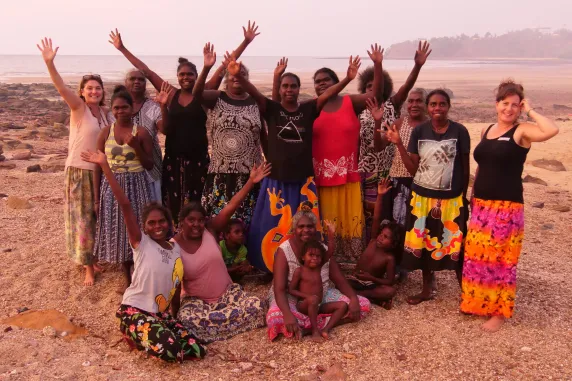
Researchers at Charles Darwin University (CDU) are set to redesign maternity services to use Yolŋu knowledge and non-Yolŋu knowledge at Galiwin’ku, Elcho Island in Arnhem Land.
New funding of about $1.5 million from the Federal Government’s National Health and Medical Research Council (NHMRC) Partnership Project scheme will ensure that on-country maternity services reach communities where the premature birth rate is three times the national average.
The partnership-based research project To Be Born Upon a Pandanus Mat (Yothuw gayatha dhäwal’ guyaŋa’nharaw) is led by Professor of Indigenous Health Yvette Roe, a proud Njikena Jawuru woman, and Professor Sue Kildea, Co-Directors of the Molly Wardaguga Research Centre at CDU.
The research project aims to redesign the approach to health services by increasing continuity and quality of maternity care as women move through services in Galiwin’ku (remote community), Nhulunbuy (regional hospital) and Darwin (tertiary referral).
“Solutions (to reduce risk for pregnant women) must enable Yolŋu to use Yolŋu knowledges to work side by side with non-Yolŋu knowledges,” Professor Roe said.
Professor Roe said the Birthing on Country service had already shown a 38 per cent reduction in preterm birth, neonatal nursery admissions, number of planned caesareans and epidural pain relief in an urban setting.
The Federal Government’s contribution adds to the $2.7 million the partner organisations are also committing to this five-year project.
Professor of Midwifery, Sue Kildea said this is an example of how partnerships between First Nations communities, clinicians, policy advisors and researchers come together to make positive and intergenerational change.
“This project builds upon 25 years of health services research,” Professor Roe said.
“Preterm birth is the largest contributor to infant and child mortalityand associated with significant long-term health problems and lifelong inequity including developmental and behavioural problems, negative impacts to schooling and educational attainment, childhood disability and chronic diseases in adulthood.”
This new service builds on the Caring for Mum on Country project led by CDU’s Associate Professor and Yolgnu cultural knowledge holder Elaine Lawurrpa Maypilama and Dr Sarah Ireland.
The First Nations families in the East Arnhem region suffer one of the highest proportion of babies being born too soon in Australia (18 to 22 per cent versus 7 per cent for non-Indigenous Australians). The team believe that can reverse this trend by providing community designed services that are clinically and culturally safe for families.
Federal Government Minister for Indigenous Australians Ken Wyatt said integration of the skills and knowledge of community with western clinical knowledge was critical to sustainable health outcomes.
“This project will help create a birthing experience for expectant mothers that is clinically safe, connected to Country and strongly steeped within culture and traditions,” Minister Wyatt said.
Related Articles
Federal funding for Country-based health and climate resilience
A new research collaboration to support and strengthen Country-based health and climate resilience has received funding through the National Health and Medical Research Council’s Centres of Research Excellence scheme.
Read more about Federal funding for Country-based health and climate resilience
New livestream brings remote Australian arid zone waterhole to the world
A new livestream from a remote waterhole in the Northern Territory is giving people around the world the opportunity to observe wildlife in real time.
Read more about New livestream brings remote Australian arid zone waterhole to the world
How ants are cashing in on the fight against money laundering
An AI model inspired by ants, bees, and birds could be the key to cracking down on blockchain-based money laundering, new research led by Charles Darwin University (CDU) has found.
Read more about How ants are cashing in on the fight against money laundering


