News
Rescued ‘old man’ turtle released back to sea
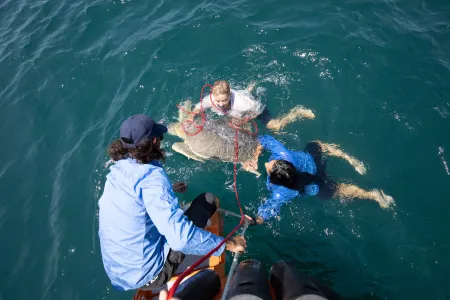
Researchers from Charles Darwin University (CDU) and Larrakia Rangers have released a 100-year-old flatback sea turtle back into the ocean after rescuing and rehabilitating it.
The flatback turtle named ‘old man’ was found during a dolphin survey from Darwin Harbour to Fog Bay in October as part of CDU’s Marine Megafauna Project in partnership with Sea Darwin and Larrakia Rangers.
After realising the turtle was unable to dive, CDU marine biologist Dr Carol Palmer and Larrakia rangers jumped overboard to retrieve the ‘old man’ turtle to the boat and the rangers worked to lift him on board the vessel.
The turtle was then sent it to the Arc Vet where the staff nursed him back to health.
“Saving a flatback turtle of his age is very rare and we were so lucky that we could help save ‘old man turtle’,” Dr Palmer said.
“Flatbacks turtles are important marine animals and unique to Northern Australia. We have the responsibility to protect and save them.”
Flatback turtles breed and nest only in Australia and are listed as vulnerable under the Australian Commonwealth’s Endangered Species Act.
The ‘old man’ turtle has made a full recovery and returned to his natural habitat with the help of researchers, rangers and vets.
As part of the three-year Marine Megafauna Project funded by the Australian Research Council, CDU researchers are working with Traditional Owners, rangers and government agencies to develop new approaches to improve marine and coastal biodiversity monitoring, research and conservation management.
The project collects data on coastal dolphins, marine turtles and a range of other understudied tropical marine megafauna such as false killer whales and manta rays.
Related Articles
Federal funding for Country-based health and climate resilience
A new research collaboration to support and strengthen Country-based health and climate resilience has received funding through the National Health and Medical Research Council’s Centres of Research Excellence scheme.
Read more about Federal funding for Country-based health and climate resilience
New livestream brings remote Australian arid zone waterhole to the world
A new livestream from a remote waterhole in the Northern Territory is giving people around the world the opportunity to observe wildlife in real time.
Read more about New livestream brings remote Australian arid zone waterhole to the world
Leading scientist recognised for lifetime of dedication to Australian biodiversity and conservation
One of the nation’s most distinguished experts in Australian biodiversity and conservation will be celebrated in an upcoming Charles Darwin University graduation ceremony.
Read more about Leading scientist recognised for lifetime of dedication to Australian biodiversity and conservation


