Rooting out plant diseases: Are computers ready to run our farms?
Nature is still too complex for artificial intelligence (AI) modelling to be effective, but the tipping point is close, according to a new study that found the technology may still trip at the last real-world hurdle.
The study into how AI can help protect crops from diseases and improve food security by identifying diseases and forecasting outbreaks, has revealed that most AI models that work in the computer lab are overwhelmed when put into the field.
There is growing interest in using AI in crop protection because infectious plant diseases, if unchecked, can compromise anywhere from 10 to 40 per cent of a farm’s crop yield depending on the disease. The diseases could cause nutritional deficiencies among crops typically rich in vitamins and minerals.
In recent years, machine and deep learning algorithms have served as the backbone of mobile applications, drone-base monitoring, automated irrigation and treatment systems, and precision agriculture platforms that have advanced to reliably recognise budding diseases.
But in-field applicability remains one of the major challenges faced by the growing technology.
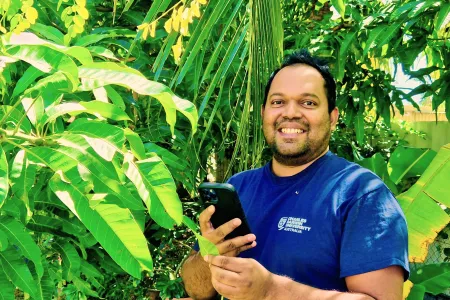
Study supervisor Dr Thuseethan Selvarajah, a CDU Lecturer in Information Technology, said real-world agricultural scenarios were often more complex than AI models are capable analysing, leading to misdiagnoses and inappropriate treatment recommendations.
Dr Selvarajah said the study highlighted the need to develop diverse, real-world plant disease datasets that capture the variability in crop types, disease stages, and environmental conditions to train AI models.
“Some of the more common field issues that affect an AI model’s accuracy include changes in lighting, overlapping leaves, background clutter, and inconsistent image quality,” he said.
“Techniques like data augmentation, domain adaptation, and training AI models to handle noise and distortions would help overcome this, but it’s also important to create lightweight and efficient deep learning models that can be used on resource-limited devices like smartphones and drones.
“In regions like Darwin and across the Northern Territory where network coverage can be limited, deploying AI models directly on mobile devices is critical because it allows farmers to access these tools without needing a constant internet connection.”
University of Peradeniya PhD candidate Romiyal George, who led the study, said healthy crops were crucial for feeding communities, preserving biodiversity, and supporting economic development around the world but the growing threat of plant diseases puts all of this at risk.
Mr George said farmers had historically relied on visual inspection of crops to monitor the presence of plant diseases – a method that is time-consuming, costly, and often inaccurate.
“A deep learning model trained on images of plant leaves showing different stages of disease can spot early signs of infection with high accuracy,” he said.
Catching these symptoms early is crucial because traditional visual checks often miss them until the disease has already advanced, leading to more severe crop loss.
“In comparison, AI systems powered by deep learning can provide immediate feedback, helping farmers make quicker and better decisions.”
This research was published in Computers and Electronics in Agriculture and contributes to Goal 2 of the United Nations Sustainable Development Goals, which relates to zero hunger.
Related Articles

Partnership with Indonesian university to support education and research
A new partnership with one of East Java’s leading education institutions is aligning Charles Darwin University with priorities to strengthen Australia’s relationship with Indonesia.
Read more about Partnership with Indonesian university to support education and research
Federal funding for Country-based health and climate resilience
A new research collaboration to support and strengthen Country-based health and climate resilience has received funding through the National Health and Medical Research Council’s Centres of Research Excellence scheme.
Read more about Federal funding for Country-based health and climate resilience
New livestream brings remote Australian arid zone waterhole to the world
A new livestream from a remote waterhole in the Northern Territory is giving people around the world the opportunity to observe wildlife in real time.
Read more about New livestream brings remote Australian arid zone waterhole to the world


