Scholar lends expertise on Mozart mystery in upcoming documentary
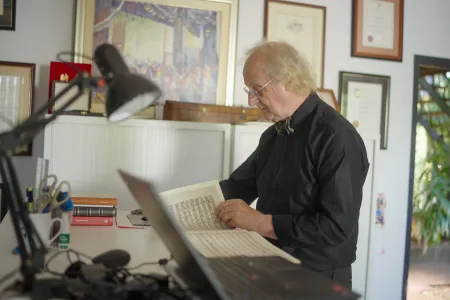
Professor Martin Jarvis AO was about 14 years old and a scholarship student at the Royal Welsh College of Music when he began to learn Mozart’s Violin Concerto No. 2 in D major.
His instincts prompted him to question whether the piece was truly composed by one of the greatest figures in the history of Western music.
Decades and an abundance of investigation later, the Charles Darwin University (CDU) musical scholar’s action on his instincts have brought him to be featured in the upcoming documentary Mozart’s Sister, highlighting the talent and genius of Wolfgang Amadeus Mozart’s sister, collaborator and composer Marie Anne Mozart.
Professor Jarvis, alongside colleagues in Australia and the United States, began investigating Mozart’s violin concertos in 2005, identifying a difference in handwriting on the scores and the signatures of two authors: the great composer himself signing as W A Mozart, and a person called Amadeo Wolfgango Mozart.
“What we discovered is that Amadeo Wolfgango Mozart is the pseudonym that Marie Anne Mozart wrote her music under that name,” Professor Jarvis said.
The documentary, produced by Sky Originals and directed by Madeleine Hetherton-Miau, recounts Marie Anne’s time in the spotlight with her brother as musical partners and collaborators and explores why she was forced to retire and what happened to her music.
In the film, which features interviews with classical musicians and experts from around the world, Professor Jarvis poses the question: Who was Amadeo Wolfgango Mozart?
“She was five years older than her brother. We can initially see her in the role of teacher to her brother, maybe an inspiration to her brother,” Professor Jarvis said.
“Marie Anne Mozart was an extremely gifted musician and a composer in her own right. We know this because Mozart even comments in some of his letters about her.”
Professor Jarvis said while the documentary helped push Marie Anne’s name and talent to a mainstream audience, it also highlights the importance of recognising women who made significant contributions to art, music, and the broader society.
“There was more than one Mozart and most importantly, this is recognition that female composers were alive and well in 17th century, the 18th century, 19th century and beyond,” Professor Jarvis said.
“They just didn’t have positions in society where their music could be performed. Female composers are just as skilled as males.”
Professor Jarvis’ research into the contribution of women in music composition is not limited to Marie Anna Mozart.
In 2011 Professor Jarvis published Written by Mrs Bach, a book suggesting some, if not all, of Johannes Sebastian Bach’s acclaimed ‘Cello Suites’ were composed by his second wife Anna Magdalena. That provocative investigation was later made into a documentary broadcast by the BBC in 2015 and is available on Amazon Prime.
Mozart’s Sister will be screened at Darwin’s Deckchair Cinema on Thursday, October 31.
Related Articles

The good, the bad, and the ugly food: Why religious shoppers are buying bruised veggies
A recent study with Charles Darwin University examines how consumers’ religiosity influences the purchase of “ugly foods”, or foods that are aesthetically imperfect but nutritious.
Read more about The good, the bad, and the ugly food: Why religious shoppers are buying bruised veggies
Rangers reimagine AI in wildlife monitoring
As workplaces around the world wrestle to integrate Artificial Intelligence in their operations, researchers and rangers in the heart of West Arnhem are successfully embracing this technology in conservation without compromising respect and knowledge.
Read more about Rangers reimagine AI in wildlife monitoring
Partnership with Indonesian university to support education and research
A new partnership with one of East Java’s leading education institutions is aligning Charles Darwin University with priorities to strengthen Australia’s relationship with Indonesia.
Read more about Partnership with Indonesian university to support education and research


