The secret life of remote dogs
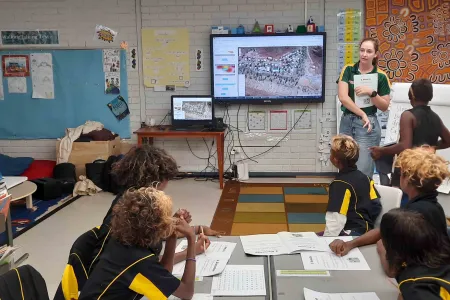
Researchers have been teaching primary school students how to track their pet dogs in remote areas using GPS tracking devices as part of a new outreach program in remote parts of the Territory.
The program ‘The Secret Life of Remote Dogs’ was a two-week education program, which ran in communities near Alice Springs as a part of a new partnership with Charles Darwin University (CDU), Inspire NT and Animal Management in Rural and Remote Indigenous Communities (AMRRIC).
The program had two parts and was supported by MacDonnell Regional Council. AMRICC’s education part of the program taught students in the participating communities about animal empathy, needs, and care, as well as a focus on cats in communities.
But for the first-time, the program included CDU researchers, who taught scientific method to children in remote communities, by helping them to develop a research project tracking their animals through the GPS dog tracking exercise.
Five communities in the MacDonnell Regional Council in Alice Springs area were visited including Santa Teresa, Wallace Rockhole, Hermannsburg, Areyonga and Amoonguna, with two dogs in each community tagged with GPS tracking collars for a week.
Students were asked to design a research study where they tagged their pet dogs with GPS to discuss and predict where they thought their dogs would travel to during the day and night, and why they might be going to certain places.
The students later analysed the data and were able to view maps of locations of the dogs, heat maps of where they have spent the most time and graphs of speed and distance on the computer.
CDU PhD student and Inspire NT Officer, Amy Kirke, said some of the remote dogs travelled distances of up to 70 kms in a single day.
“Dogs in remote communities usually have the opportunity to roam much further than dogs typically do in urban settings, so this was a fun and engaging way to teach kids the scientific method with their beloved companions,” Ms Kirke said.
“The students found that the dogs were mostly at home, the shop, or a popular community area because they wanted food, water, medicine, care, baths, family or play.”
“One of the dogs that travelled the furthest 71km in one day – he may have spent some time in a car, but we never found out for sure.”
AMRRIC Education Officer, who is also a trained veterinary nurse, Michelle Hayes said the program was a great joint initiative for the collaborators and communities involved.
“The kids were really engaged, and the two parts of the program synced nicely together to reinforce the value of science in everyday life and support the promotion of responsible pet ownership,” Ms Hayes said.
Related Articles

Federal funding for Country-based health and climate resilience
A new research collaboration to support and strengthen Country-based health and climate resilience has received funding through the National Health and Medical Research Council’s Centres of Research Excellence scheme.
Read more about Federal funding for Country-based health and climate resilience
New livestream brings remote Australian arid zone waterhole to the world
A new livestream from a remote waterhole in the Northern Territory is giving people around the world the opportunity to observe wildlife in real time.
Read more about New livestream brings remote Australian arid zone waterhole to the world
How ants are cashing in on the fight against money laundering
An AI model inspired by ants, bees, and birds could be the key to cracking down on blockchain-based money laundering, new research led by Charles Darwin University (CDU) has found.
Read more about How ants are cashing in on the fight against money laundering


