News article
Shark scientist wins rural women’s bursary
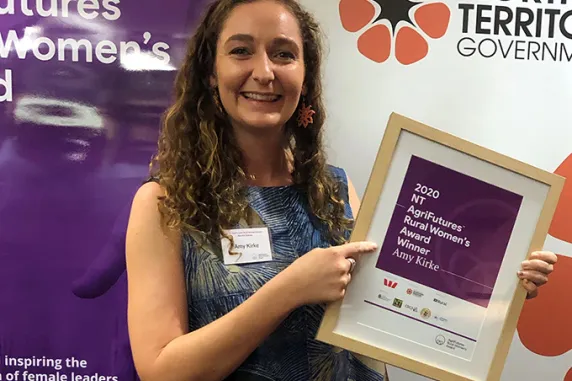
PhD candidate Amy Kirke will represent the Northern Territory at the National Rural Women’s Award after winning the AgriFutures NT Rural Women’s Award for a project to take science education into remote communities.
Ms Kirke said she planned to use the $10,000 Westpac bursary on a project to deliver STEM engagement workshops in rural communities.
“A passion of mine is to bring science education to rural and remote communities and I was drawn to the idea to use industry to benefit my community in the NT,” Ms Kirke said.
“With an industry-paired science program, we could promote collaboration, sustainability and innovation for the future of the NT.
“There’s a huge capacity among remote communities to be involved in the sustainable management of their resources.”
The AgriFutures Rural Women’s Award is presented each year to inspire and support Territory women in the rural sector.
Ms Kirke said the first step would be to engage communities to assess their level of interest, commitment and priorities.
“I’m planning to trial the program in Darwin, but the aim is to take it to Katherine, Tiwi and Arnhem Land.”
Ms Kirke, who moved to the NT two years ago, is working with NT Fisheries on a biological and ecological study of sharks to give resource managers a better understanding of various species of shark.
“I’m looking at Whitecheek Shark, Milk Shark and the Hardnose Shark, all of which incidentally are caught in commercial fishing. I’m collecting important data on factors such as reproductivity, numbers, locations, age and growth,” she said.
Related Articles

Trainer’s passion to help students succeed recognised
While Veeramani Ramasami used his studies to launch an early career as an accountant and financial Manager, it was the encounter with his first accounting teacher that inspired him on a different path into education.
Read more about Trainer’s passion to help students succeed recognised
Prisoner education and skills training success
More than 2000 prisoners across the Northern Territory have taken part in education and skills training through a Charles Darwin University partnership with NT Corrections.
Read more about Prisoner education and skills training success
New livestream brings remote Australian arid zone waterhole to the world
A new livestream from a remote waterhole in the Northern Territory is giving people around the world the opportunity to observe wildlife in real time.
Read more about New livestream brings remote Australian arid zone waterhole to the world


