News
Slums can provide lessons for building effective circular cities

The slums in the global south hold the key to building circular cities in other developing countries, according to Charles Darwin University (CDU) researchers.
Slums, a term used to describe informal settlements within cities with mostly insecure land tenure, and inadequate access to safe water, sanitation and housing, are often perceived to carry significant societal, environmental, and other costs.
Advancing a slum–circular economy model for sustainability transition in cities of the Global South, published in the prestigious Nature Sustainability journal, looks at circular economy (CE) habits in slums in a range of countries, including Mexico, South Africa, India, Brazil, Kenya, Bangladesh and Angola.
The study, led by CDU researchers Dr Matthew Abunyewah and Dr Michael Odei Erdiaw-Kwasie, aims to offer directions for future slum-CE research and policy in the global south.
This research comes at a time when the urban share of the global population has dramatically increased over time, with substantial growth projected to occur in the developing world.
Dr Abunyewah said this rising trend in the urban share of global populations poses tremendous stress on the environment and finite resources.
“Unfortunately, population growth is inevitably linked to higher demand for food, water and infrastructure,” Dr Abunyewah said.
“These concerns have led to global calls to think about ways to slow and narrow resource use.”
The recently published article offers a model that maps the activities of those living in slums and how the practices and processes underlying slum life intersect with the key principles of CE.
“Through this research, we mapped the three core elements of slums, namely livelihoods, housing and spaces and then explained their synergies with CE principles,” Dr Abunyewah said.
“Overall, the everyday practices in slums reflect the ten elements underpinning the circular economy, which brings into sharp focus the intricate connections between slum life and CE principles.”
“Evidence shows that slum dwellers in a range of areas, including Durban in South Africa and Lima in Peru, make a living from waste picking and sorting and scrutinise waste to help identify recyclable materials that could be sold for income,” Dr Odei Erdiaw-Kwasie said.
“In India’s largest slum in Dharavi, waste sorting and recycling accounts for 60 to 80 per cent of waste recycling in Mumbai and waste pickers contribute to closing the loop through the recycling and reuse chain, which are integral to a CE and the building of circular cities.”
“The findings also corroborate the argument that the ideas inherent in the CE are not new, which shows that underlying principles are already deeply embedded and inseparably connected to many of the everyday life-making strategies of slum dwellers,” Dr. Odei Erdiaw-Kwasie said.
The research also showed that slum dwellers have a high-level knowledge of CE practices and experiences and exhibit a high commitment to promoting circular waste design interventions.
This is particularly important when thinking about the potential of developing relationships between urban planning authorities and slum dwellers to help promote circular cities in developing countries.
“We can argue that slum dwellers with knowledge and experience in the CE will be active rather than passive stakeholders, which will help engagement levels,” Dr Abunyewah said.
“Through this research, we have revitalised the potential of the urban poor and marginalized communities to help stimulate activities capable of accelerating the realisation of the circular cities agenda in developing countries.”
The article can be found in Nature Sustainability.
Related Articles
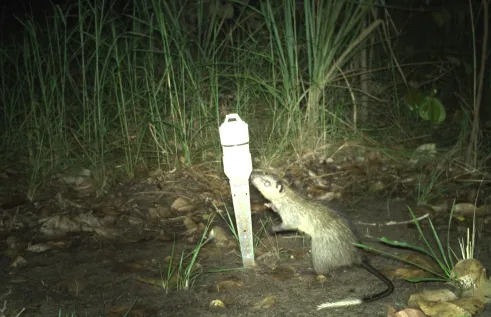
Rangers reimagine AI in wildlife monitoring
As workplaces around the world wrestle to integrate Artificial Intelligence in their operations, researchers and rangers in the heart of West Arnhem are successfully embracing this technology in conservation without compromising respect and knowledge.
Read more about Rangers reimagine AI in wildlife monitoring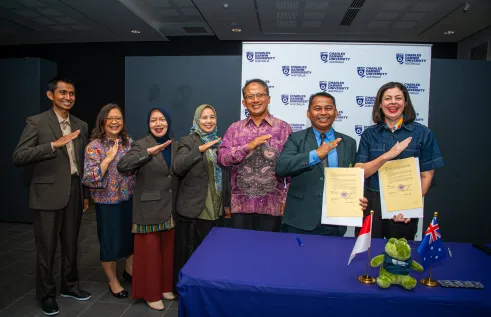
Partnership with Indonesian university to support education and research
A new partnership with one of East Java’s leading education institutions is aligning Charles Darwin University with priorities to strengthen Australia’s relationship with Indonesia.
Read more about Partnership with Indonesian university to support education and research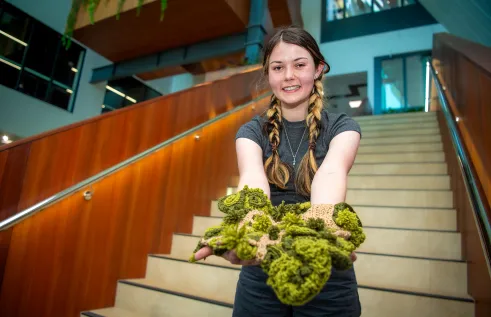
Crocheted landscape takes the gold in architecture competition
When tasked to defy growing reliance on artificial intelligence and create a landscape model without digital tools, Charles Darwin University (CDU) Bachelor of Architectural Design student Jorja Handebo turned to her hobby of the past five years: crochet.
Read more about Crocheted landscape takes the gold in architecture competition


