News article
Students call to reduce single-use plastics
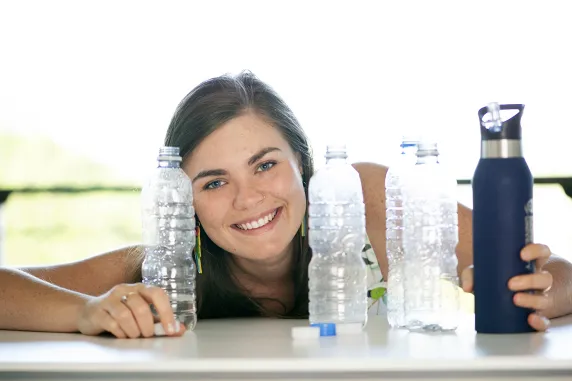
A Charles Darwin University environmental action group is lending its support to Plastic Free July, an initiative that encourages people to be part of the solution to plastic pollution.
Bachelor of Science (Hons) student Brittany Hayward Brown is President of EnviroCollective CDU, which has launched a social media campaign providing tips and tricks to help people reduce their single-use plastic consumption.
“EnviroCollective’s aim is to promote environmental awareness and behavioural change on our campuses and in the wider community,” Brittany said.
“This month, we want to raise awareness of the long-lasting impact of single use plastic items such as bottles, bags, cups and straws.
“Millions of these items are thrown away every day but the fact is they are derived from fossil fuels; they don’t break down, and this has a detrimental effect on our environment, including accelerating climate change.”
Brittany said that an estimated eight million tonnes of plastic end up in the world’s oceans each year.
“Here’s another scary fact: A recent study found that each week people ingest up to five grams of micro plastics into our digestive system. That’s roughly equivalent to eating a credit card each week.”
Brittany said it was a pervasive issue, but there was hope.
“We need to raise greater awareness and engage people at a grass roots level to change their thinking and their behaviour,” she said.
“The more people who give it a go – who reduce their use of one-off plastics – the better off we’ll be.
“One thing that inspires me is to see the ripple effects of change. If we can encourage a few people to change their habits this has great potential to influence others. One small action can contribute to the broader change we need to see in our society.”
She said July, or indeed any time, was a good time to start a good habit.
“Give it a try,” she said. “What’s the worst that could happen if we prevent tonnes of plastic going into the ocean?”
Connect with EnviroCollective CDU online at W: facebook.com/EnviroCollectiveCdu/
Related Articles
New livestream brings remote Australian arid zone waterhole to the world
A new livestream from a remote waterhole in the Northern Territory is giving people around the world the opportunity to observe wildlife in real time.
Read more about New livestream brings remote Australian arid zone waterhole to the world
Leading scientist recognised for lifetime of dedication to Australian biodiversity and conservation
One of the nation’s most distinguished experts in Australian biodiversity and conservation will be celebrated in an upcoming Charles Darwin University graduation ceremony.
Read more about Leading scientist recognised for lifetime of dedication to Australian biodiversity and conservation
New construction management course to bolster NT’s building industry
A new Master of Construction Management from Charles Darwin University (CDU) is set to bolster the Northern Territory’s building industry.
Read more about New construction management course to bolster NT’s building industry


