Study suggests online delivery trumps the classroom to teach students

Online learning can increase a student’s short and long-term memory by improving their cognitive capacity, according to a new study examining the uptick of digital education during COVID-19.
The study by Charles Darwin University (CDU), alongside Holy Angel University in the Philippines, explored the use of online learning by undergraduate accounting students after it was introduced at a university in the Southeast Asian country during the COVID-19 pandemic.
Researchers surveyed 482 first, second, and third-year students studying an accountancy degree in the 2020 to 2021 academic year. It was the first time the subject university had introduced online learning, with teaching conducted over live-streams and students required to attend online classes.
Lead author and CDU Professor of Accounting Indra Abeysekera said while students were receptive to online education, they encountered difficulties learning from poor teaching quality and hard-to-use learning management systems.
“These difficulties resulted in overwhelming students and increasing their cognitive load, or the amount of information their working memories can process at any given time,” Professor Abeysekera said.
Professor Abeysekera said if the quality of online learning is high, it can help students manage their cognitive load and thus improve their memory.
“To meet that promise, teaching quality can be improved with instructors having up-to-date knowledge and understanding of the learning materials, being willing to help students with learning, providing learning materials consistent with the syllabus, and empathising with students to encourage and motivate students to their best,” he said.
“Learning management systems also play a crucial role. Learning content must be available and directly related to their learning outcomes. Decreasing cognitive load in these ways can help to improve students' short-term memory through high electronic learning quality and satisfaction. When these favourable effects are repeated, it can elicit students' behaviours towards retaining learning for the long term.”
Professor Abeysekera said future avenues of research from this study included exploring if university-level learning could be brought to mobile phones.
“Online education has opened up possibilities to reach a wider population to share knowledge and skills, and universities can play a leading role in reaching the rural poor. There is a strong positive correlation between education and poverty reduction in the Philippines,” he said.
“Smartphones open up the possibility of reaching out to a greater population to take up university education such as undertaking accounting degree studies.”
“ChatGPT can complement this with easily accessible knowledge, which has reset what is known, can be known, and is beyond knowledge. These tools can help decrease educational institution costs and costs of student learning, increase education quality, and reduce social inequality.”
The Effect of Cognitive Load on Learning Memory of Online Learning Accounting Students in the Philippines was published in the journal Sustainability.
Related Articles

The good, the bad, and the ugly food: Why religious shoppers are buying bruised veggies
A recent study with Charles Darwin University examines how consumers’ religiosity influences the purchase of “ugly foods”, or foods that are aesthetically imperfect but nutritious.
Read more about The good, the bad, and the ugly food: Why religious shoppers are buying bruised veggies
Rangers reimagine AI in wildlife monitoring
As workplaces around the world wrestle to integrate Artificial Intelligence in their operations, researchers and rangers in the heart of West Arnhem are successfully embracing this technology in conservation without compromising respect and knowledge.
Read more about Rangers reimagine AI in wildlife monitoring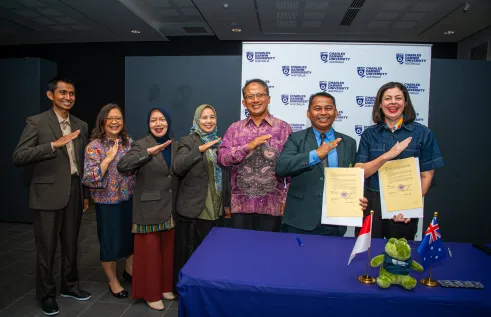
Partnership with Indonesian university to support education and research
A new partnership with one of East Java’s leading education institutions is aligning Charles Darwin University with priorities to strengthen Australia’s relationship with Indonesia.
Read more about Partnership with Indonesian university to support education and research


