News
Uniting industry to investigate mitigation of threatened species bycatch in commercial net fisheries
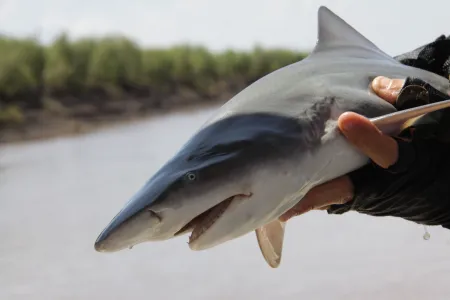
Charles Darwin University (CDU) is leading an ambitious new collaborative project that will look to mitigate threatened ray and shark bycatch in northern Australian net fisheries.
The project brings together professional fishers, industry consultants, fisheries managers, and researchers across the Northern Territory, Western Australia, and Queensland to investigate strategies for reducing catch rates of threatened sharks and rays and improve the sustainability of northern Australia’s commercial net fisheries.
Several northern Australian fisheries use panels of netting with mesh that are held vertically in the water column, either attached to fishing vessels or anchored to the ocean floor.
These nets are effective at catching target commercial fish species but can also incidentally catch other marine animals such as threatened sharks and rays as bycatch.
Research Fellow from CDU’s Research Institute for the Environment and Livelihoods (RIEL), Dr Joni Pini-Fitzsimmons, who will be working on the project said the overarching aim is to lessen, or ideally eliminate, interaction between nets and threatened species.
“This project will not only benefit these remarkable creatures but also bolster the sustainability of the seafood industry,” Dr Pini-Fitzsimmons said.
“It holds the potential to drastically reduce the bycatch of numerous threatened species of sharks and rays that call our northern waters home, including sawfish, river sharks, and devil rays.”
The project will look to evaluate the efficacy of novel mitigation devices designed to deter threatened species from nets as well as investigating alternative fishing gear to minimise bycatch whilst maintaining the target catches such as barramundi, grey mackerel, and king threadfin.
The project is a collaboration between, and has also received co-investment from, CDU, Northern Territory Department of Industry, Tourism and Trade, Western Australian Department of Primary Industries and Regional Development, Rob Fish, C-AID Consultants, Atlantis Fisheries Consulting Group, Wild Barra Fisheries, and Wren Fishing Group.
Wren Fishing Group, an industry leader in the sustainable development, investment, and catch of seafood in Australia will assist with testing of bycatch mitigation devices for offshore net fisheries in northern Australia as part of this project.
These devices have reduced bycatch of sharks and rays by up to 90 per cent overseas and have the potential to increase the sustainability of northern Australian net fisheries.
Wren Fishing Group Financial Coordinator Tina Hutchinson said the project will strengthen the environmental stewardship and economic and social outcomes of net fisheries in Northern Australia.
“Wren Fishing is excited by the opportunity to participate in what promises to be ground-breaking research, the outcomes of which may be applicable to fisheries Australia-wide,” Ms Hutchinson said.
“It is research like this that further boosts Australian consumer confidence in their favourite seafood, knowing it has been sourced by world-leading professional fishing practices and methods.”
Wild Barra Fisheries CEO Cameron Berryman said that this collaborative effort underscores the commitment of the fishing industry to sustainable fishing practices and the preservation of threatened species.
“Partnerships and collaborations like this are invaluable to delivering the best environmental, social, and economic outcomes for Australia’s fisheries and communities,” Mr Berryman said.
The project, which is funded through the Threatened and Migratory Species Fisheries Bycatch Mitigation Program administered by the Australian Government, is scheduled to run until June 2025.
Related Articles
Federal funding for Country-based health and climate resilience
A new research collaboration to support and strengthen Country-based health and climate resilience has received funding through the National Health and Medical Research Council’s Centres of Research Excellence scheme.
Read more about Federal funding for Country-based health and climate resilience
New livestream brings remote Australian arid zone waterhole to the world
A new livestream from a remote waterhole in the Northern Territory is giving people around the world the opportunity to observe wildlife in real time.
Read more about New livestream brings remote Australian arid zone waterhole to the world
Leading scientist recognised for lifetime of dedication to Australian biodiversity and conservation
One of the nation’s most distinguished experts in Australian biodiversity and conservation will be celebrated in an upcoming Charles Darwin University graduation ceremony.
Read more about Leading scientist recognised for lifetime of dedication to Australian biodiversity and conservation


