Northern Institute
Health of Priority Waterholes and Digital Confidence with Warddeken (Daluk) Rangers
| Presenter | Co-presented by Dr Cara Penton, Suzannah Nabulwad and Dr Jennifer Macdonald | |
|---|---|---|
| Date/Time |
to
|
|
| Contact person |
Northern Institute
|
|
| Location | Room 02, Level 5 Danala Education and Community Precinct 54 Cavenagh Street, Darwin City, NT, 0800 | |
| Open to | Public | |
About
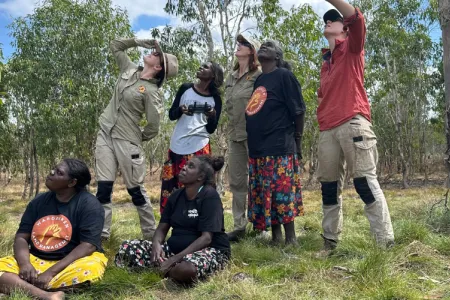
In the Warddeken Indigenous Protected Area, daluk (women) rangers and researchers have co-designed a project to monitor priority waterholes using digital tools. Through micro-credential badges co-developed by women rangers through the Healthy Country AI Program and Northern Institute (CSIRO and CDU partnership), rangers are building digital skills and confidence to assess country. This action research supports Traditional Owners and Custodians to collect, care, and tell a story with data to guide local decision-making and care for freshwater places. Together the presenters will discuss the journey in developing the micro-credentials, how these were applied for ecological research, and what we learnt together about the impacts on biocultural values of waterholes from feral species.
Presenters
Suzannah Nabulwad is from Mamadawerre outstation where she is Djunkay (caretaker) and a Traditional Owner of Madjawarr Estate in the Warddeken Indigenous Protected Area. She is a Senior Daluk (Women) ranger at Warddeken Land Management and Chairwomen of the Digital Women Boss Committee that governs the Digital Women Ranger Program. Working in land management for over twelve years Suzannah has vast amount of experience caring for Country through managing weeds, fire, protecting threatened ecological communities, and monitoring significant species and places with digital tools such as camera traps and mapping. Conducting this work right through proper engagement and employment of Traditional Owners in program works. Suzannah has been a co-investigator and digital mentor at Warddeken Land Management exploring the impact of feral animals on priority waterholes.
Jennifer Macdonald is a Research Fellow with the Northern Institute working on a CDU-CSIRO postdoc which is focused on culturally appropriate ways to assess the benefits and risks associated with digital innovation for on-Country decision-making. She is working with Indigenous women rangers in northern Australia on projects which seek to understand and support the co-design of digital tools to monitor and manage significant species and places and ensure local benefit and empowerment. Jennifer’s background is in human geography and science and technology studies (STS).
Dr Cara Penton is a cross-cultural ecologist and research fellow at Warddeken Land Management Ltd and Charles Darwin University, working in partnership with local communities in the remote stone country of West Arnhem Land. She holds a PhD in conservation ecology and brings a unique systems-thinking lens to conservation challenges. She is deeply committed to supporting Indigenous-led conservation and strengthening the role of community-driven monitoring and management in protecting Australia’s unique biodiversity. From fire and feral animal management to threatened species monitoring, she works alongside Indigenous rangers to co-develop practical tools and strategies that support long-term ecological and cultural outcomes.
You can register the event:
Related Events

Seen, Heard, Counted: The power and importance of the Census in 2026
Join us in the lead up to the census, and understand its importance for Australias future.
Read more about Seen, Heard, Counted: The power and importance of the Census in 2026
Last refugium of a critically endangered species: Three decades of conservation
The Banggai Crow (Corvus unicolor), is one of the world’s most threatened endemic species. The bird survives in an increasingly fragmented refugium within the Banggai Archipelago, Central Sulawesi.
Read more about Last refugium of a critically endangered species: Three decades of conservation
Marine science in the NT: From research and monitoring to stock assessment
In this seminar, the team will provide an overview of fisheries research in the Northern Territory, highlighting monitoring programs, data collection, and how these activities inform stock assessment and fisheries management
Read more about Marine science in the NT: From research and monitoring to stock assessment


