
Update your personalisation settings to view information about this course.
This course is only available to Domestic students and your preference is currently set to International.
This course is only available to International students and your preference is currently set to Domestic.
Key details
Duration
Locations
Entry requirements
View full entry requirementsCredit points required
40Course code
Overview
The Graduate Certificate in Spatial Science complements your current science qualifications and will further develop your professional skill set. This course is designed for professionals, across a wide-range of vocations, seeking to gain expertise in spatial science at postgraduate level.
This stand-alone course belongs to a pathway between graduate certificate, graduate diploma and Master of Environmental Management.
You are not expected to have previous experience in the spatial science field; however, if you do have some background, the repeatable placement unit allows the inclusion of project work in the unit selection.
Career opportunities
Graduating from this course may lead to career opportunities in government, private companies and non-government organisations (NGO) as GIS technicians, remote sensing analysts, spatial ecologists, project managers, and geospatial modellers.
Credit transfers and advanced standing
Pathways
Pathways for Higher Education to Higher Education
For information about credit transfer available to students with complete or incomplete study at this or other Institutions refer to Pathways for Higher Education to Higher Education
Credit transfer
For further information on credit transfer and how to apply visit ASK CDU
Credit transfers and advanced standing
Credit transfer
For further information on credit transfer and how to apply visit ASK CDU
Fees
Non-Commonwealth supported places
Full fee paying places are available in this course.
Information about fees and charges can be found at Fees and Payments.

Why study science or the environment at CDU?
Interested in solving our planet's biggest environmental issues? There's never been a better time to study a postgraduate degree in science, environmental science and management with CDU. Gain advanced skills and knowledge that help progress your career. Apply critical thinking to future-focused solutions across real-world problems.
- #2 Australian university for postgraduate employment outcomes (GUG 2024)
- Choose to study online, on campus, part-time or full-time as it suits you
Why study science or the environment at CDU?
If you're interested in finding solutions to our planet's environmental issues, there's never been a better time to study science, environmental science and management at CDU. You'll be prepared to apply the academic theories and principles you learn in class to real-world problems in a diverse range of careers.
- #2 Australian university for postgraduate employment outcomes (GUG 2024)
Why study science or the environment at CDU?
Interested in solving our planet's biggest environmental issues? There's never been a better time to study a postgraduate degree in science, environmental science and management with CDU. Gain advanced skills and knowledge that help progress your career. Apply critical thinking to future-focused solutions across real-world problems.
- #2 Australian university for postgraduate employment outcomes (GUG 2024)
- Choose to study online, on campus, part-time or full-time as it suits you
Why study science or the environment at CDU?
If you're interested in finding solutions to our planet's environmental issues, there's never been a better time to study science, environmental science and management at CDU. You'll be prepared to apply the academic theories and principles you learn in class to real-world problems in a diverse range of careers.
- #2 Australian university for postgraduate employment outcomes (GUG 2024)
What will I study?
The Graduate Certificate in Spatial Science provides a package of applied spatial science units and includes a placement project option for those with existing experience in spatial science.
Course structure
The course stresses both the importance of theory and the application of theory in practice through projects and practical exercises.
Those completing the Graduate Certificate in Spatial Science may be eligible to articulate into the Master of Applied Spatial Science or the Graduate Diploma and Master of Environmental Management with full credit transfer.
A candidate must successfully complete units totalling 40 credit points (cp) as detailed below. All units are valued at 10 credit points unless otherwise indicated.
| Unit type | Credit Points | Specific requirements |
| Specialist Electives (4 units) | 40cp | Specialist Elective units totalling 40 credit points as detailed below. ENV502 Earth Observation |
| 40cp | Total Credit Points |
Course Rules (unless otherwise indicated in the above course structure)
- See the Higher Education Course Rules (Award Requirements) in the Units and Courses Policy.
COURSE CHANGES AND TRANSITIONAL ARRANGEMENTS - 2022
Students who have completed SID500 should not complete ENV518.
COURSE CHANGES AND TRANSITIONAL ARRANGEMENTS - 2018
ENV508 Applied Geographic Information Systems is now Geographic Information Systems and Spatial Thinking.
ENV518 Advanced Spatial Science is now Analysing and Synthesising Spatial Data.
Study plan
STUDENTS COMMENCING IN SEMESTER 1
The Recommended Study Plan provided below is suitable for a student enrolling in a part-time study load. Students entering this course with advanced standing, or wishing to vary their study plan due to work, personal, financial or other reasons should use the table as a guide to create an individual study plan.
When designing an individual study plan:
- maintain the basic order in which units are to be attempted; and
- check the prerequisite and assumed knowledge for each unit as some units assume you have completed foundation unit/s in the unit area at a lower level.
| Legend: | CO = Core Unit | R = Research | SE = Specialist Elective |
Part-Time Study Plan
| Semester 1 | Intensive 6 | ||
| Year 1 | |||
| ENV502 Earth Observation | CO | ENV506 Environmental Monitoring and Modelling | CO |
| ENV508 Geographic Information Systems | CO | ENV518 Applied Spatial Analysis for Real-World Problems (title changed 2023) | CO |
_____________________________________
STUDENTS COMMENCING IN SEMESTER 2
There is no Semester 2 entry into this course.
Entry requirements
Admission criteria
Successful completion of a recognised bachelor's degree or equivalent international qualification.
Essential requirements
English language requirements
DOMESTIC STUDENTS
To be eligible for admission to this course, applicants must meet the standard English language proficiency requirements for Higher Education courses at Charles Darwin University (CDU) and provide evidence as part of their application.
You can meet the minimum English language requirement by providing evidence of one of following:
| Previous study in English |
|
| AHPRA Registration | Current registration with the Australian Health Practitioner Regulation Agency (AHPRA). |
| English Test^ | Completion of an approved English Test within two years of commencement, with the minimum scores shown below. |
| Primary language pathway | Completion of six years of primary and/or secondary schooling in a recognised English-speaking country*, including at least two years between years 7-12. |
Additional information about accepted tests and the evidence requirements is available on the English language proficiency requirements page.
^English tests - approved tests and minimum scores
| Undergraduate and postgraduate pathway program requirement | Postgraduate requirement (HDR and coursework) | |
| CDU ELICOS - English for Academic Purposes | Successful completion of EAP003 | Successful completion of EAP004 |
| International English Language Testing System (IELTS) Academic test | Overall minimum: 6.0 No band below: 6.0 | Overall minimum: 6.5 No band below 6.0 |
| Pearson Test of English (PTE) Academic | Overall minimum: 50 No score below: 50 | Overall minimum: 58 No score below: 50 |
| Test of English as a Foreign Language (TOEFL) | Overall minimum: 60 Minimum writing score: 21 | Overall minimum: 79 Minimum writing score: 21 |
| Cambridge English: Advanced (CAE) | Overall minimum: 169 No skill below: 169 | Overall minimum: 176 No skill below: 169 |
Information about test validity, accepted combined test results, IELTS One Skill Retake and evidence requirements is available on the English language proficiency requirements page.
*Recognised English-speaking countries:
| Standard List | Antigua and Barbuda, Australia, Barbados, British Virgin Islands, Canada, Ireland, New Zealand, Singapore, South Africa, United Kingdom, United States of America. |
| Extended List | Bermuda, Botswana, Cayman Islands, Fiji, Kenya, Malawi, Malta, Mauritius, Seychelles, St Vincent and the Grenadines, Tanzania, Trinidad and Tobago, Vanuatu, Zimbabwe. |
All previous studies must have been delivered in English (medium of instruction was English). Applicants who have studied at an institution from a coutnry on the extended list must provide confirmation that their study was completed within the last five years.
For further details on the English requirements for CDU courses, please refer to the CDU English Language Proficiency Policy.
The people-first approach to flexibility and supportive learning environment at CDU meant I could find a balance with study, work and family life.
Nikki
CDU student

I am very proud that I am now an environmental expert who can work anywhere on this planet. There is nothing that can be done on the development of any projects without environmental experts. So, it is a very promising career.
Cassian
CDU student

The people-first approach to flexibility and supportive learning environment at CDU meant I could find a balance with study, work and family life.
Nikki
CDU student
I am very proud that I am now an environmental expert who can work anywhere on this planet. There is nothing that can be done on the development of any projects without environmental experts. So, it is a very promising career.
Cassian
CDU student
Course details
Accreditation
This course is accredited by the University in accordance with the Higher Education Standards.
Australian qualification framework
This course is recognised in the Australian Qualifications Framework at Level 8.
Additional information
Contact details
For further information about the course, enrolment procedures, closing dates and other administrative issues please contact Student Central on:

You make CDU
Together we are a positive force for change in our communities and the world.
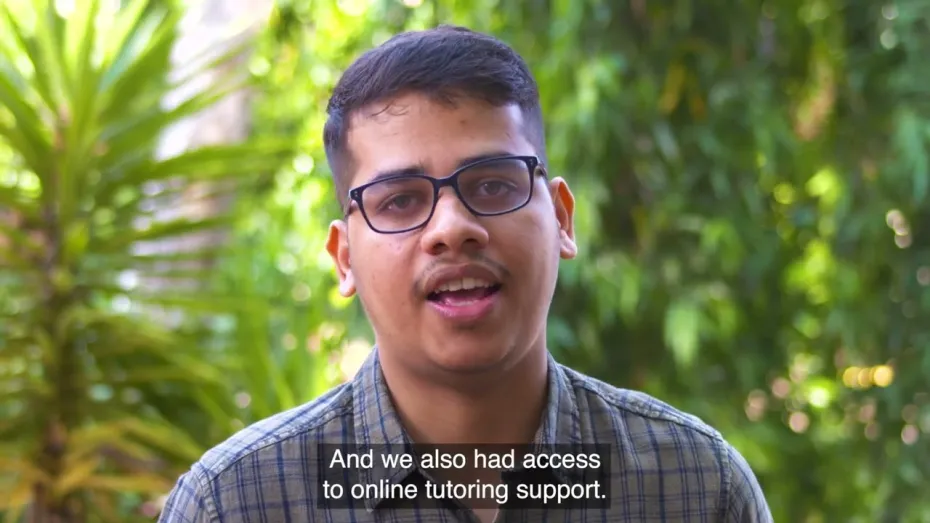
Learn more about environmental management
Vamshidhar is from India and studied a Master of Environmental Management at CDU. Hear more about his experience of studying, living, working and playing in Darwin, Northern Territory, Australia.
You make CDU
Together we are a positive force for change in our communities and the world.
Learn more about environmental management
Vamshidhar is from India and studied a Master of Environmental Management at CDU. Hear more about his experience of studying, living, working and playing in Darwin, Northern Territory, Australia.
How to apply
There are many ways to apply to CDU. The method you use depends on your course type, where you live and whether you are a new or returning student to CDU.
Remember to apply early for your best chance at securing an offer to study with us.
SATAC
SATAC is the application channel for residents of NT, ACT, SA, WA, QLD, VIC, NSW or TAS.
Share this course