
Update your personalisation settings to view information about this course.
This course is only available to Domestic students and your preference is currently set to International.
This course is only available to International students and your preference is currently set to Domestic.
Key details
Duration
Locations
Entry requirements
View full entry requirementsCredit points required
80Course code
Overview
Environmental science and environmental management at Charles Darwin University are research-intensive, dynamic disciplines, situated within some of the most spectacular and fascinating natural and cultural environments in Australia.
The Graduate Diploma of Environmental Management provides postgraduate education for existing and future professionals on the background, principles and practices of environmental management, particularly in the context of wet-dry and semi-arid tropical ecosystems and arid landscapes. The generic skills concepts and applications covered in this course are also highly relevant to those working in other ecosystems.
The course also includes a focus on the social context within which environmental management takes place. This two semester course enables you to select specific units which address your interests and career directions, while also giving you the option to smoothly articulate, with full credit, into the Master of Environmental Management.
Unit selection allows you to focus on ecology, policy, livelihoods and spacial science and their application.
There are opportunities for intensive units with remote field locations, and there are sometimes international study opportunities available. Graduates of this program are equipped to work within the diverse range of disciplines and sectors involved in effective and sustainable ecosystem management, and are eligible to apply for membership of associations such as the Ecological Society of Australia (ESA) and the Environmental Institute of Australia and New Zealand (EIANZ).
Career opportunities
Depending on unit choices, this course can either provide a skills update and refresh for established environmental professionals, or the opportunity for new graduates to fill identified skills gaps on the path to becoming ready for employment.
Credit transfers and advanced standing
Pathways
Pathways for Higher Education to Higher Education
For information about credit transfer available to students with complete or incomplete study at this or other Institutions refer to Pathways for Higher Education to Higher Education
Credit transfer
For further information on credit transfer and how to apply visit ASK CDU
Credit transfers and advanced standing
Credit transfer
For further information on credit transfer and how to apply visit ASK CDU
Fees
Non-Commonwealth supported places
Full fee paying places are available in this course.
Information about fees and charges can be found at Fees and Payments.

Why study science or the environment at CDU?
Interested in solving our planet's biggest environmental issues? There's never been a better time to study a postgraduate degree in science, environmental science and management with CDU. Gain advanced skills and knowledge that help progress your career. Apply critical thinking to future-focused solutions across real-world problems.
- #2 Australian university for postgraduate employment outcomes (GUG 2024)
- Choose to study online, on campus, part-time or full-time as it suits you
Why study science or the environment at CDU?
If you're interested in finding solutions to our planet's environmental issues, there's never been a better time to study science, environmental science and management at CDU. You'll be prepared to apply the academic theories and principles you learn in class to real-world problems in a diverse range of careers.
- #2 Australian university for postgraduate employment outcomes (GUG 2024)
Why study science or the environment at CDU?
Interested in solving our planet's biggest environmental issues? There's never been a better time to study a postgraduate degree in science, environmental science and management with CDU. Gain advanced skills and knowledge that help progress your career. Apply critical thinking to future-focused solutions across real-world problems.
- #2 Australian university for postgraduate employment outcomes (GUG 2024)
- Choose to study online, on campus, part-time or full-time as it suits you
Why study science or the environment at CDU?
If you're interested in finding solutions to our planet's environmental issues, there's never been a better time to study science, environmental science and management at CDU. You'll be prepared to apply the academic theories and principles you learn in class to real-world problems in a diverse range of careers.
- #2 Australian university for postgraduate employment outcomes (GUG 2024)
What will I study?
The flexible course structure allows choice among units that focus on ecology, policy, livelihoods and spatial science, and their application. Student-centred, resource and activity-based learning materials provide a stimulating program that is balanced between updating content knowledge and technical skills, developing conceptual skills, and the application of these for natural resource management within its social context. The program responds to the changing needs of employers and other stakeholders, with the latest outcomes of regional research incorporated into learning materials, and taught by research active academic staff. Small class sizes mean that all students have ready access to staff, via collegial distance or face-to-face interactions.
Course structure
Students can undertake the course fully externally or internally, or a combination of both, depending on unit selection. Internally-enrolled students attend tutorials on campus, while having full access to the materials provided to external students. Both Darwin-based and interstate students can choose to enrol into intensive units with remote field locations, and there are sometimes international study opportunities available. In this way, the course offers an exciting range of opportunities to develop field, technical and practical skills.
A candidate must successfully complete units totalling 80 credit points (cp) as detailed below. All units are valued at 10 credit points unless otherwise indicated.
| Unit type | Credit Points | Specific requirements |
| Core Units (2 units) | 20cp | Core Units totalling 20 credit points as listed below. ENV513 Environmental Planning and Policy |
| Specialist Elective Units (6 units) | 60cp | Specialist Elective units totalling 60 credit points selected from the units listed below. ENV501 Tropical Invaders and Biosecurity |
| 80cp | Total Credit Points |
Course Rules (unless otherwise indicated in the above course structure)
- See the Higher Education Course Rules (Award Requirements) in the Units and Courses Policy.
COURSE CHANGES AND TRANSITIONAL ARRANGEMENTS - 2026
ENV523 Ecological Economics has been added as a specialist elective.
SID515 Professional Practice in Environmental Management 2 has been added as a specialist elective.
COURSE CHANGES AND TRANSITIONAL ARRANGEMENTS - 2025
ENV521 Community Engagement for Biosecurity and Natural Resources Management has been removed from core units and added as a specialist elective
SID510 Advanced Communication and Engagement in Science and Technology replaces ENV521 Community Engagement for Biosecurity and Natural Resource Management as a core unit
Students who have completed ENV521 Community Engagement in Science and Technology prior to 2025 will have it counted towards their core units.
COURSE CHANGES AND TRANSITIONAL ARRANGEMENTS - 2024
The course structure has changed for 2024
- Specialist Elective units A and B have been combined into one Specialist Elective selection.
- Specialist Electives ENV513 Environmental Planning and Policy and ENV521 Community Engagement for Biosecurity and Natural Resource Management have been moved into Core Units to reflect the structure of the Masters Program, and facilitate articulation between the two courses.
COURSE CHANGES AND TRANSITIONAL ARRANGEMENTS - 2018
ENV508 Applied Geographic Information Systems is now Geographic Information Systems and Spatial Thinking.
ENV512 Tropical Wetland and Coastal Management has been replaced by ENV519 Aquatic Resource Management.
ENV518 Advanced Spatial Science is now Analysing and Synthesising Spatial Data.
Study plan
STUDENTS COMMENCING IN SEMESTER 1
The Recommended Study Plan provided below is suitable for a student enrolling in a full-time study load. Students entering this course with advanced standing, or wishing to vary their study plan due to work, personal, financial or other reasons should use the table as a guide to create an individual study plan.
When designing an individual study plan:
- maintain the basic order in which units are to be attempted; and
- check the prerequisite and assumed knowledge for each unit as some units assume you have completed foundation unit/s in the unit area at a lower level.
| Legend: | CO = Core Unit | SE = Specialist Elective |
Full-Time Study Plan
| Semester 1 | Semester 2 | ||
| Year 1 | |||
| ENV513 Environmental Planning and Policy | CO | SID510 Advanced Communication and Engagement in Science and Technology (replaces ENV521 from 2025) (available INT-6 only) | CO |
| Specialist Elective 1 | SE | Specialist Elective 4 | SE |
| Specialist Elective 2 | SE | Specialist Elective 5 | SE |
| Specialist Elective 3 | SE | Specialist Elective 6 | SE |
_____________________________________
STUDENTS COMMENCING IN SEMESTER 2
The Recommended Study Plan provided below is suitable for a student enrolling in a full-time study load. Students entering this course with advanced standing, or wishing to vary their study plan due to work, personal, financial or other reasons should use the table as a guide to create an individual study plan.
When designing an individual study plan:
- maintain the basic order in which units are to be attempted; and
- check the prerequisite and assumed knowledge for each unit as some units assume you have completed foundation unit/s in the unit area at a lower level.
| Legend: | CO = Core Unit | SE = Specialist Elective |
Full-Time Study Plan
| Semester 1 | Semester 2 | ||
| Year 1 | |||
| SID510 Advanced Communication and Engagement in Science and Technology (replaces ENV521 from 2025) (available INT-6 only) | CO | ||
| Specialist Elective 1 | SE | ||
| Specialist Elective 2 | SE | ||
| Specialist Elective 3 | SE | ||
| Year 2 | |||
| ENV513 Environmental Planning and Policy | CO | ||
| Specialist Elective 4 | SE | ||
| Specialist Elective 5 | SE | ||
| Specialist Elective 6 | SE | ||
Entry requirements
Admission criteria
Successful completion of a recognised bachelor degree, graduate certificate, graduate diploma, masters degree or equivalent international qualification.
Essential requirements
English language requirements
DOMESTIC STUDENTS
To be eligible for admission to this course, applicants must meet the standard English language proficiency requirements for Higher Education courses at Charles Darwin University (CDU) and provide evidence as part of their application.
You can meet the minimum English language requirement by providing evidence of one of following:
| Previous study in English |
|
| AHPRA Registration | Current registration with the Australian Health Practitioner Regulation Agency (AHPRA). |
| English Test^ | Completion of an approved English Test within two years of commencement, with the minimum scores shown below. |
| Primary language pathway | Completion of six years of primary and/or secondary schooling in a recognised English-speaking country*, including at least two years between years 7-12. |
Additional information about accepted tests and the evidence requirements is available on the English language proficiency requirements page.
^English tests - approved tests and minimum scores
| Undergraduate and postgraduate pathway program requirement | Postgraduate requirement (HDR and coursework) | |
| CDU ELICOS - English for Academic Purposes | Successful completion of EAP003 | Successful completion of EAP004 |
| International English Language Testing System (IELTS) Academic test | Overall minimum: 6.0 No band below: 6.0 | Overall minimum: 6.5 No band below 6.0 |
| Pearson Test of English (PTE) Academic | Overall minimum: 50 No score below: 50 | Overall minimum: 58 No score below: 50 |
| Test of English as a Foreign Language (TOEFL) | Overall minimum: 60 Minimum writing score: 21 | Overall minimum: 79 Minimum writing score: 21 |
| Cambridge English: Advanced (CAE) | Overall minimum: 169 No skill below: 169 | Overall minimum: 176 No skill below: 169 |
Information about test validity, accepted combined test results, IELTS One Skill Retake and evidence requirements is available on the English language proficiency requirements page.
*Recognised English-speaking countries:
| Standard List | Antigua and Barbuda, Australia, Barbados, British Virgin Islands, Canada, Ireland, New Zealand, Singapore, South Africa, United Kingdom, United States of America. |
| Extended List | Bermuda, Botswana, Cayman Islands, Fiji, Kenya, Malawi, Malta, Mauritius, Seychelles, St Vincent and the Grenadines, Tanzania, Trinidad and Tobago, Vanuatu, Zimbabwe. |
All previous studies must have been delivered in English (medium of instruction was English). Applicants who have studied at an institution from a coutnry on the extended list must provide confirmation that their study was completed within the last five years.
For further details on the English requirements for CDU courses, please refer to the CDU English Language Proficiency Policy.
The people-first approach to flexibility and supportive learning environment at CDU meant I could find a balance with study, work and family life.
Nikki
CDU student

I am very proud that I am now an environmental expert who can work anywhere on this planet. There is nothing that can be done on the development of any projects without environmental experts. So, it is a very promising career.
Cassian
CDU student

The people-first approach to flexibility and supportive learning environment at CDU meant I could find a balance with study, work and family life.
Nikki
CDU student
I am very proud that I am now an environmental expert who can work anywhere on this planet. There is nothing that can be done on the development of any projects without environmental experts. So, it is a very promising career.
Cassian
CDU student
Course details
Australian qualification framework
This course is recognised in the Australian Qualifications Framework at Level 8.
Additional information
Contact details
For further information about the course, enrolment procedures, closing dates and other administrative issues please contact Student Central on:

You make CDU
Together we are a positive force for change in our communities and the world.
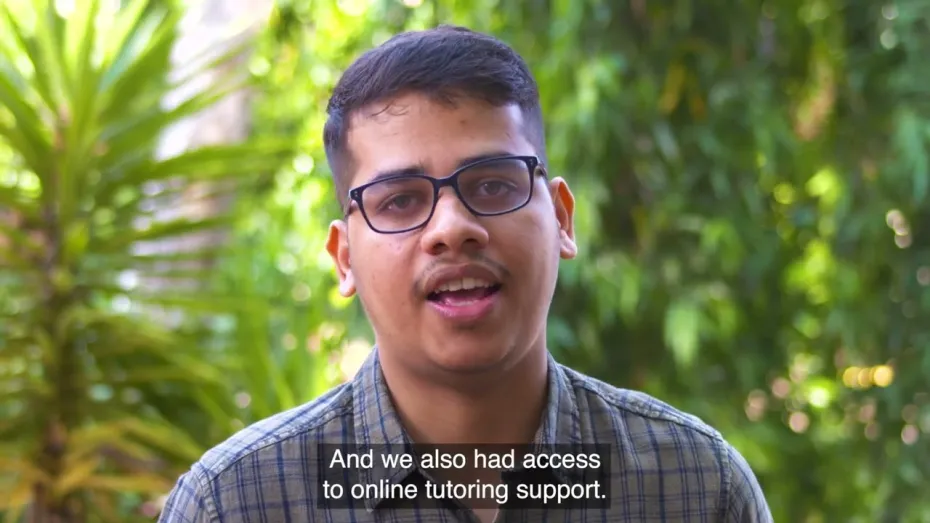
Learn more about environmental management
Vamshidhar is from India and studied a Master of Environmental Management at CDU. Hear more about his experience of studying, living, working and playing in Darwin, Northern Territory, Australia.
You make CDU
Together we are a positive force for change in our communities and the world.
Learn more about environmental management
Vamshidhar is from India and studied a Master of Environmental Management at CDU. Hear more about his experience of studying, living, working and playing in Darwin, Northern Territory, Australia.
How to apply
There are many ways to apply to CDU. The method you use depends on your course type, where you live and whether you are a new or returning student to CDU.
Remember to apply early for your best chance at securing an offer to study with us.
SATAC
SATAC is the application channel for residents of NT, ACT, SA, WA, QLD, VIC, NSW or TAS.
Share this course