Research impact
Following the flock: Samantha’s research could revolutionise water point placement

When Samantha first moved to South Australia's harsh outback, she was confronted by what she saw.
"Having recently moved to arid pastoral South Australia, I was struck by the hot, dry climatic conditions," she says. "I found myself questioning what made these landscapes so resilient, how livestock production could thrive in such conditions and whether this relationship was truly sustainable."
As she rode through the paddocks, she noticed something troubling.
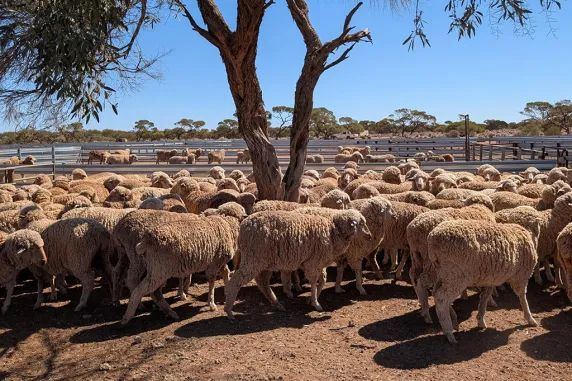
Around every watering point, the vegetation was badly damaged, with some plants eaten down to nothing. The pattern seemed to follow the prevailing wind direction. She found herself asking: How could these landscapes be so tough yet so fragile?
From observation to solution
Samantha's journey started with a degree in Agricultural Science. A unit called Sustainable Food Systems stood out for her, showing how complex our food supply really is – every person in the chain matters, from producers to consumers.
Those rides through damaged paddocks sparked her research passion. If she could understand sheep grazing patterns, she might be able to help farmers protect their land and remain viable.
Now a Higher Degree by Research candidate at Charles Darwin University and based at the Research Institute for Northern Agriculture (RINA), Samantha has become something of a sheep detective. She fits GPS tracking collars onto sheep and monitors their movements over several weeks. A weather station in the same paddocks measures temperature, wind and conditions.
Her detective work involves cross-referencing GPS data with weather information to understand sheep behaviour. Where do they go when it's windy? How does temperature affect grazing patterns? How does managing access to water influence environmental impact?
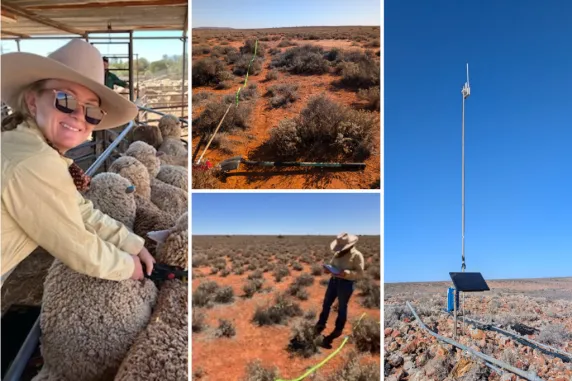
Samantha's research includes extensive fieldwork.
"I hope with my findings, pastoralists will consider weather conditions and trends when installing new water points for livestock in extensive grazing systems," Samantha says.
This research is crucial for Australia's hot, dry interior. As climate change intensifies these conditions, sustainable farming solutions will need to be found.
Flexible study options
For Samantha, Charles Darwin University offered the perfect solution for pursuing her Higher Degree by Research while living remotely in South Australia's pastoral zone.
"The flexibility of part-time study, but more importantly, the ability to complete my degree as an external student living remotely, made this possible," she says.
"It is a wonderful university with great support and enthusiasm for asking questions and finding answers to problems which may shape the future."
Researchers like Samantha are pioneering solutions to help pastoral industries thrive despite the shifting climate challenges. Her innovative approach shows how the right questions and methods can benefit everyone from farmers to consumers.
Today, Samantha no longer just observes problems in those paddocks – she's solving them. The data from sheep GPS collars holds answers that could reshape Australian farming, proving that important discoveries often come from simply paying attention to what's happening around us.
Interested in postgraduate study with the Research Institute for Northern Agriculture? See what projects are available.
Related Articles
Finding Community in CDU
Why Alcyonie chose Environmental Science at CDU
Read more about Finding Community in CDU
The NT inspired Kate to become an environmental scientist
A road trip around Australia sparked a huge career change for Kate. The recent Bachelor of Environmental Science graduate switched gears from real estate to environmental science after falling in love with the uniqueness of the Northern Territory.
Read more about The NT inspired Kate to become an environmental scientist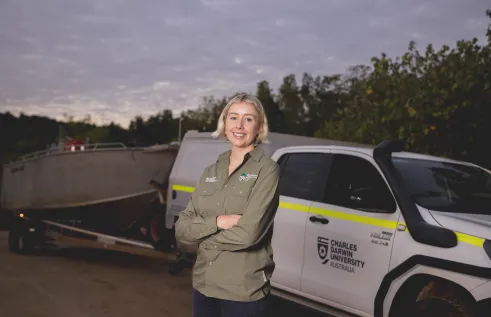
Julia's unexpected road to species-saving research
Julia is researching sharks and rays here in the Top End at Charles Darwin University, a world away from her upbringing in north-western NSW. She's working to ensure some of Australia's most threatened species are around for many generations to come.
Read more about Julia's unexpected road to species-saving research


