News
$1.2m partnership for robots to fix roads
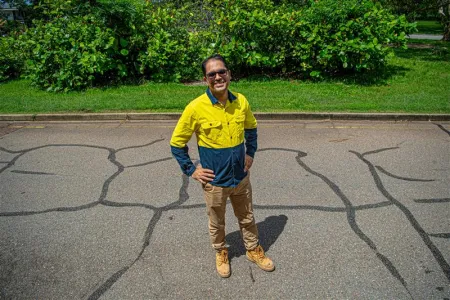
An AI-powered robotic system will soon detect and repair cracked roads thanks to a $1.2 million partnership between Charles Darwin University (CDU), Civiltech Solutions, and the Additive Manufacturing Cooperative Research Centre (AMCRC).
The industry-research partnership will combine LiDAR road scanning, artificial intelligence, robotics, and additive manufacturing to solve one of the most common costly challenges faced in road maintenance – all with minimal human intervention.
Australia has more than 800,000 kilometres of roads, most managed by local governments. While early crack sealing can significantly extend pavement life, current maintenance practices rely heavily on manual inspection and application, which can miss early-stage defects and lead to inconsistent repairs.
Researchers from CDU’s Centre for Asphalt and Road Technologies (CART), who have received half a million in funding as part of the partnership, will contribute their expertise in robotics, materials engineering and additive manufacturing to build on Civiltech Solutions’ existing LiDAR-based road scanning platform.
CART Director Ali Rajabipour said the collaboration demonstrated valuable applications for emerging technologies in addressing real-world infrastructure challenges.
“This project brings together a range of technologies and industry insights to solve real-world infrastructure problems while building advanced engineering capability in the Northern Territory,” Dr Rajabipour said.
Civiltech Solutions Founder and Chief Executive Officer Leigh Carnall said the project represented a major step toward modernising road maintenance.
“Road maintenance is still largely manual and reactive,” Mr Carnall said.
“By combining AI, robotics and advanced manufacturing, we can detect defects earlier and repair them with far greater precision, helping road authorities maintain networks more efficiently.”
Additive manufacturing will enable the design and production of lightweight, custom components for the robotic dispensing system, allowing for the optimisation of operation in harsh environments and remote locations.
The project also demonstrates how additive manufacturing can be applied beyond traditional factory environments.
Managing Director of the Additive Manufacturing CRC Simon Marriott said the project demonstrates how additive manufacturing can enable entirely new approaches to infrastructure maintenance.
“Additive manufacturing allows highly specialised components to be designed and produced both rapidly and cost effectively, which is critical when developing advanced robotic systems,” Marriott said.
“This collaboration highlights how industry and research organisations can work together to develop scalable solutions that improve productivity, sustainability and capability across Australia’s infrastructure sector.”
Once demonstrated, the technology has the potential to scale across Australia’s road network, helping councils and road authorities extend pavement life, reduce maintenance costs and improve road safety through more proactive and data-driven maintenance.
Aligned with the United Nations Sustainable Development Goals
Industry, innovation and infrastructure
Goal 9
Build resilient infrastructure, promote inclusive and sustainable industrialization and foster innovation.
Sustainable cities and communities
Goal 11
Make cities and human settlements inclusive, safe, resilient and sustainable.
Partnerships for the goals
Goal 17
Strengthen the means of implementation and revitalize the Global Partnership for Sustainable Development.
Related Articles

Federal funding for Country-based health and climate resilience
A new research collaboration to support and strengthen Country-based health and climate resilience has received funding through the National Health and Medical Research Council’s Centres of Research Excellence scheme.
Read more about Federal funding for Country-based health and climate resilience
New livestream brings remote Australian arid zone waterhole to the world
A new livestream from a remote waterhole in the Northern Territory is giving people around the world the opportunity to observe wildlife in real time.
Read more about New livestream brings remote Australian arid zone waterhole to the world
Leading scientist recognised for lifetime of dedication to Australian biodiversity and conservation
One of the nation’s most distinguished experts in Australian biodiversity and conservation will be celebrated in an upcoming Charles Darwin University graduation ceremony.
Read more about Leading scientist recognised for lifetime of dedication to Australian biodiversity and conservation


