Is academic ‘TikTok’ the future of learning?

There could be more value to vlogging than trying to become an internet personality, with a recent study exploring how the practice could boost university student engagement and ensure their work is authentic.
The study by Charles Darwin University (CDU) and the University of Queensland explores the classroom integration of vlogging platform Microsoft Flip, focusing on its use by university academics during a three-year pilot.
Microsoft Flip (Flip), which has since been integrated into assignments within Microsoft Teams, allows teachers to set assignments using text or video instructions, and students to respond with videos.
Ten academics were asked how useful they considered the platform to be in higher education, what challenges they encountered with it, and what their suggestions were to improve it.
The academics used Flip as a way to assess students’ language skills in speaking assignments by recording themselves reciting poems and simulating conversations in real-life scenarios.
Students were also asked to interact with one another by debating via video and record themselves reflecting on what they’d learned in their course.
Lead author and CDU digital initiatives expert Dr Seb Dianati said the consensus of the academics was the platform was effective for engaging younger generations.
“Vlogging aligns with the engagement strategies that students are familiar with from social media platforms like Instagram, TikTok, and Snapchat,” Dr Dianati said.
“By leveraging these formats, vlogging keeps students connected, engaged, and invested in their learning. It allows for continuous, authentic feedback from both peers and instructors, ensuring that assessments are active, personalised, and ongoing, fostering a deeper and more interactive learning experience.”
Dr Dianati added in the age of generative Artificial Intelligence, vlogging platforms could allow teaching staff to verify the authenticity of a student’s work and better understand the competency of learners.
“Engagement through interactivity in vlogging offers students meaningful ways to connect with both their peers and instructors,” Dr Dianati said.
“This interaction not only builds a collaborative learning environment but also deepens students' understanding by encouraging shared exploration, communicative confidence, and offers a method to ensure academic integrity within assessments.
“Vlogging is already widely accepted in primary and secondary education, where it’s really taken off as an engaging learning tool. But in tertiary education we’re still lagging a bit behind. I think part of it is that universities are often slower to adopt new technologies at scale, and there’s a potential missed opportunity here.”
The academic TikTok: Academics’ perceptions and uses of Microsoft Flip as a vlogging platform was published in the Australasian Journal of Educational Technology.
Related Articles
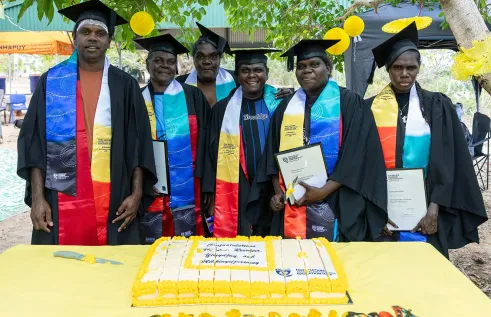
First Nations Training and Teacher Education Hub celebrates first major milestone
As Charles Darwin University's (CDU) First Nations Training and Teacher Education Hub draws closer to the end of its first year, one of its greatest milestones to date was conferring its first six graduates.
Read more about First Nations Training and Teacher Education Hub celebrates first major milestone
Federal funding for Country-based health and climate resilience
A new research collaboration to support and strengthen Country-based health and climate resilience has received funding through the National Health and Medical Research Council’s Centres of Research Excellence scheme.
Read more about Federal funding for Country-based health and climate resilience
New livestream brings remote Australian arid zone waterhole to the world
A new livestream from a remote waterhole in the Northern Territory is giving people around the world the opportunity to observe wildlife in real time.
Read more about New livestream brings remote Australian arid zone waterhole to the world


