Battle-ready medical drones to join Army’s ranks
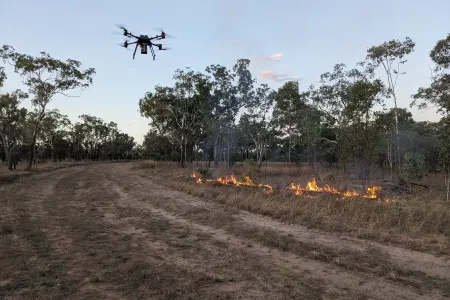
A new drone delivery project led by Charles Darwin University (CDU) aims to revolutionise healthcare in modern warfare.
The project, led by the North Australia Centre for Autonomous Systems (NACAS) at CDU and supported by the Queensland Defence Science Alliance (QDSA), will focus on solving the technical, logistical and regulatory challenges of integrating large, heavy-fuel cargo drones into the battlefield operating system.
NACAS will work with Queensland uncrewed aerial systems (UAS) manufacturer SAIDYNAMICS to adapt their hybrid 2-stroke engine drone for long-range, cold-chain cargo operations.
The project will also partner with Griffith University’s Centre for Enterprise Architecture Research and Management to develop navigation algorithms for drones to locate drop-off locations in GPS-degraded environments.
Visual line-of-sight trials are set to begin over the coming months in the Northern Territory, with longer beyond-visual line-of-sight trials (BLVOS) to start with regulatory approval.
NACAS Professor Hamish Campbell said the Australian government was investing heavily into sovereign capability for the manufacture of UAS, but far less attention was being paid to solving the challenges of integrating these platforms into existing operating systems and the national airspace.
Professor Campbell said the Northern Territory’s low ground infrastructure and sparse population made it an ideal location for the project’s flight trials.
“NACAS is one of the leading organisations in Australia for research into UAS airspace integration, and this will be bolstered by the opening of the new Airspace Integration Research Facility (AIR-F) later in 2025,” Professor Cambell said.
QDSA Director Stuart Blackwell said the Alliance was focused on collaborating with the best minds in the Northern Territory, Queensland, and Defense industry to solve key challenges faced by the Australian Defense Force (ADF).
“QDSA believes this particular project has real potential to solve some of the logistics distribution challenges in remote locations of Northern Australia that will benefit Defense, Queensland and the Northern Territory,” Mr Blackwell said.
CDU Deputy Vice-Chancellor Research and Community Connections Professor Steve Rogers said the University was well-placed to contribute to advancing defence capabilities.
“Australia needs to be at the forefront of defence research and innovation, and our researchers will provide strategically vital experience to these projects,” Professor Rogers said.
“Charles Darwin University became a member of the Queensland Defence Science Alliance less than a year ago and the beginning of these projects are a testament to our world-leading knowledge and capabilities.”
Northern Territory Chief Minister and Minister for Defence NT Lia Finocchiaro congratulated the grant recipients.
“This research reinforces the importance of the Northern Territory to our nation’s defence security and strategic importance in the Indo-Pacific,” Mrs Finocchiaro said.
“I look forward to showcasing the incredible capabilities of our industry at NT Defence Week in April 2025.”
Related Articles
Federal funding for Country-based health and climate resilience
A new research collaboration to support and strengthen Country-based health and climate resilience has received funding through the National Health and Medical Research Council’s Centres of Research Excellence scheme.
Read more about Federal funding for Country-based health and climate resilience
New livestream brings remote Australian arid zone waterhole to the world
A new livestream from a remote waterhole in the Northern Territory is giving people around the world the opportunity to observe wildlife in real time.
Read more about New livestream brings remote Australian arid zone waterhole to the world
Leading scientist recognised for lifetime of dedication to Australian biodiversity and conservation
One of the nation’s most distinguished experts in Australian biodiversity and conservation will be celebrated in an upcoming Charles Darwin University graduation ceremony.
Read more about Leading scientist recognised for lifetime of dedication to Australian biodiversity and conservation


