News
Bursary gets Emma on track for her sea ranger dream

Born in Katherine, Emma Barrett grew up along the Limmen River in the remote Gulf of Carpentaria. The thought of getting a university degree was almost as remote as where Emma lives.
But that changed when she received the Kennelly Construction Indigenous Research Student Bursary to study at Charles Darwin University (CDU) with a $30,000 sponsorship from Kennelly Construction under an agreement with the Northern Institute.
After completing Year 12 at Katherine High School in 2017, Ms Barrett got a “fishing job” to be one step closer to her dream of becoming a ranger.
In the two years working in fisheries, she developed a mindset to learn on the job and a thirst for more knowledge.
“If there’s an opportunity, I would take it. I just want to learn as much as I can,” Ms Barrett said.
“I think once I have lots of experience, knowledge and skills, I can do things I enjoy.”
Emma will be studying a Diploma of Indigenous Research with the Northern Institute. Her learning focus at CDU is researching seagrass because she wants to be a Sea Country ranger.
“I want to look after the ocean and get more people to come and explore our country,” she said.
Growing up on country, Ms Barrett has always been attracted by the ocean.
“My family always told me to look after our country. I’m proud to be taking that passion further and be the first in my family to go to university,” she said.
Now just starting her university studies, Ms Barrett plans to focus on her studies and gain more practical, hands-on experience to prepare herself for a career as a sea ranger.
“I want to help with fishing camps and learn more practical skills as a ranger. I’m very excited about this,” she said.
Having completed her primary schooling through remote learning, Ms Barrett is no stranger to online learning. She is undertaking her studies in both remote and on-campus modes.
Earlier in August, she arrived at the Casuarina Campus for an orientation to prepare for the new semester.
“The orientation week has really shown me the way around the University and how to use the resources. I’m getting more confident,” she said.
“I can’t wait to tell my family more about what I’m learning, and it feels I’m finally on the right track.”
Shane Kennelly, Managing Director of Kennelly Construction, said the company was proud to sponsor students like Ms Barrett to further their studies.
“Kennelly Constructions is a leading Aboriginal owned construction business which operates across Australia. At our core, we are very conscious of how we can contribute to the ongoing protection of our Country and our Culture through empowering our people such as Emma,” Mr Kennelly said.
“We are proud to provide her with an opportunity to continue her studies and play an important part in research which is focused on the conservation of dugongs and green turtles.”
To find out more about the Diploma of Indigenous Research, contact the Northern Institute at thenortherninstitute@cdu.edu.au or 08 8946 7468.
Related Articles

Darwin needs a BBL: Architecture student's vision for the Top End
A vertical promenade designed by a Charles Darwin University (CDU) architecture student and inspired by Singapore's Gardens by the Bay offers a glimpse into Darwin's future facelift.
Read more about Darwin needs a BBL: Architecture student's vision for the Top End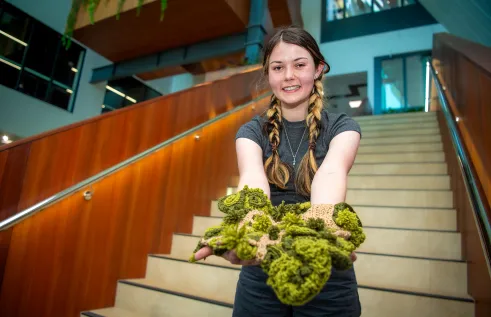
Crocheted landscape takes the gold in architecture competition
When tasked to defy growing reliance on artificial intelligence and create a landscape model without digital tools, Charles Darwin University (CDU) Bachelor of Architectural Design student Jorja Handebo turned to her hobby of the past five years: crochet.
Read more about Crocheted landscape takes the gold in architecture competition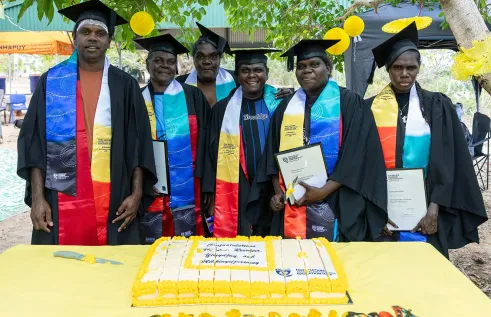
First Nations Training and Teacher Education Hub celebrates first major milestone
As Charles Darwin University's (CDU) First Nations Training and Teacher Education Hub draws closer to the end of its first year, one of its greatest milestones to date was conferring its first six graduates.
Read more about First Nations Training and Teacher Education Hub celebrates first major milestone


